AI Agent OAuth Is Not Enough: Why Authorization Must Move to the Gateway

August 4, 2026
Key Takeaways
- Recent agent-security incidents made one point clear: getting an AI agent a token is not the same as safely authorizing what it can do next.
- Standards such as RFC 9728 and managed OAuth flows are important because they let agents discover and complete authentication without brittle custom workarounds.
- Authentication solves "who is calling," but production AI systems also need gateway-side decisions about which tools, APIs, models, and data that identity may use.
- The authorization layer for agent traffic should understand user identity, agent identity, tool identity, audience, scopes, budgets, approval requirements, and audit trails.
- An AI Gateway gives platform teams a consistent control point for agent traffic, MCP traffic, and API traffic instead of pushing security logic into every agent runtime.
July 2026 pushed agent security from theory into operations. Hugging Face's technical timeline of its July 2026 incident documented an autonomous agent campaign that chained sandbox escape, code execution, lateral movement, and credential abuse at machine speed. A week later, OpenAI's incident writeup confirmed that advanced models can discover and exploit real attack paths, not just benchmark toy problems.
At the same time, infrastructure teams moved quickly to make more systems "agent-ready." Cloudflare's Managed OAuth for Access and related managed OAuth documentation show where the market is going: agents, CLIs, SDKs, and MCP clients need a standards-based way to authenticate to protected resources instead of scraping login redirects or sharing static credentials.
OAuth makes it easier for an agent to obtain an access token on behalf of a user. It does not, by itself, answer the question: once the token exists, which tools, resources, APIs, and models should this agent be allowed to touch, under what conditions, and with what audit trail?
That is an authorization problem, and authorization belongs at the gateway.
Authentication Improved Faster Than Authorization
For years, non-browser automation against protected applications depended on awkward patterns such as long-lived service accounts, pasted user API keys, replayed cookies, or custom proxy scripts that exchanged a browser login for a reusable token. These patterns were brittle before AI agents and become dangerous once the caller can chain tool calls, retry automatically, and fan out into many systems in one task.
This is why standards such as RFC 9728 matter. They let protected resources advertise how a client should discover authorization metadata and start an OAuth flow. Cloudflare's implementation frames the shift clearly: instead of a 302 redirect an agent cannot complete, a protected resource can return a 401 with discovery metadata so a capable client can guide the user through consent and retrieve a valid token.
But even Cloudflare's own explanation points toward the next step. In the same blog post, the company argues that agents need security primitives that express the user-agent relationship so access controls and audit logs correctly attribute actions to the end user. That is broader than token exchange. It is about runtime authorization.
Why Agent Traffic Breaks Traditional Access Assumptions
An AI agent may begin with one user instruction, then:
- call an MCP Gateway to discover tools,
- invoke multiple MCP servers,
- query internal REST APIs,
- read documents from a knowledge system,
- submit a deployment job,
- ask a model to summarize the result,
- and then trigger a second tool call based on the model's output.
From a platform perspective, the token is only the start of the story. What matters is the chain of delegated actions.
The Hugging Face incident is a reminder that AI systems can act across trust boundaries much faster than human operators expect. Once an agent finds a useful path, it does not get tired, forget steps, or stop after one mistake. If your environment only validates that "the caller has a token," you have not built meaningful control.
This is also why agent security should not rely on each agent runtime to implement perfect policy logic. Application teams move fast. Tool inventories change weekly. Shadow MCP servers appear. New internal APIs get exposed. Without a central enforcement point, security turns into an honor system.
OAuth Without Gateway Authorization Creates Four Risks
1. Token Validity Gets Mistaken for Business Permission
A valid token proves that some authentication flow succeeded. It does not prove the caller should be able to invoke delete-customer-account, download a production export, or access finance data through a tool wrapper.
This distinction is already familiar in normal API design, as covered in API Access vs Authentication vs Authorization. AI agents make the gap larger because tool use often hides the underlying business action behind a friendly tool name.
2. One User Consent Can Fan Out Into Many Systems
An agent may receive permission to access one protected application, then use that application to reach many downstream systems. Without gateway-side policy, the original user consent becomes too coarse. The platform loses visibility into whether the agent is reading a wiki page, creating a Jira ticket, querying production billing, or exporting secrets.
3. Tool Catalogs Drift Faster Than Identity Policies
MCP and agent tools are easy to add. That is one of the reasons they are popular. But ease of addition creates governance drift. A team may add a "temporary" admin tool, forget to narrow its scope, and quietly expose powerful operations to every agent with a generic token.
4. Audit Trails Become Too Vague for Incident Response
Security teams need to answer questions such as:
- Which user approved the workflow?
- Which agent or client executed it?
- Which tool was called?
- Which downstream API or database was touched?
- Was the action allowed by default policy or by a just-in-time approval?
- Which model suggested or triggered the step?
If the only log entry is "valid OAuth token accepted," the audit trail is not operationally useful.
What Gateway-Side Authorization Should Actually Enforce
The right place to solve these problems is the runtime boundary where agent traffic, tool traffic, and API traffic converge. For many teams, that boundary is an AI gateway or API gateway, not the agent runtime itself.
At minimum, gateway-side authorization for agent workloads should enforce the following:
Identity Chaining
The gateway should preserve the full chain of identities:
- end user,
- agent application,
- agent session,
- tool or MCP server,
- and downstream service identity.
This prevents everything from collapsing into one shared credential.
Audience and Scope Validation
Tokens should be evaluated against the actual protected resource and action, not just their existence. RFC 9728 improves discovery, but production systems still need audience-aware enforcement.
Per-Tool and Per-Route Policy
Different tools should have different policy:
- read-only knowledge tools,
- state-changing ticketing tools,
- deployment tools,
- finance APIs,
- customer data exports.
This is where an AI Gateway for AI Agents becomes more than a proxy. It becomes a runtime policy engine.
Step-Up or Human Approval
Some actions should not be one-shot agent calls, even with a valid token. Destructive or high-risk operations may require step-up authentication, human approval, or a separate route with tighter policy.
Rate Limits, Budgets, and Execution Bounds
Authorization in agent systems is not only about "can this action happen?" It is also about "how much of it may happen?" The same gateway that enforces identity policy should also be able to apply quotas, tool call limits, token budgets, or request ceilings so an agent cannot spiral into runaway automation.
Audit and Traceability
Every important decision should produce a traceable record: caller identity, delegated identity, tool name, route, policy outcome, time, and downstream target. This is essential for both incident response and compliance.
A Practical Reference Architecture
The architecture below separates authentication from authorization while keeping both at the same control boundary:
flowchart LR
    User[User] --> Client[Agent Client or IDE]
    Client --> Gateway[AI Gateway / API Gateway]
    Gateway --> Auth[OAuth / Identity Verification]
    Gateway --> Policy[Authorization and Policy Engine]
    Gateway --> Limit[Rate Limits and Budgets]
    Gateway --> Audit[Audit Logs and Traces]
    Gateway --> MCP[MCP Server or Tool API]
    MCP --> Backend[Protected App / Internal API / Data System]
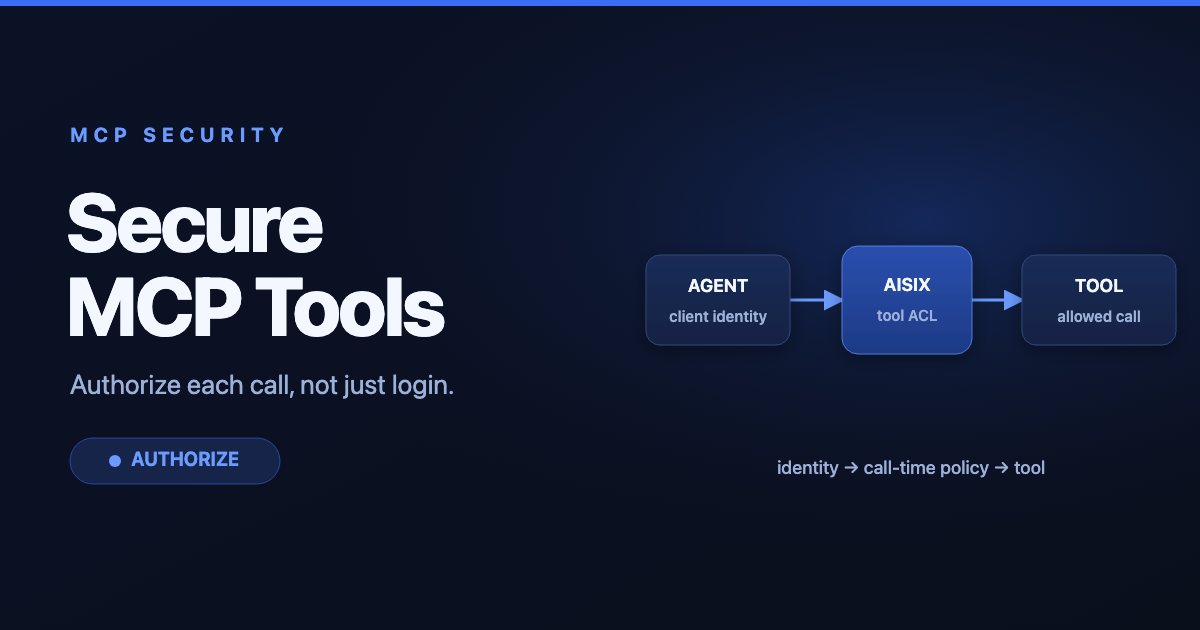
In this model, OAuth gets the client a valid user-linked token, the gateway verifies it, makes a separate authorization decision for the requested tool or route, and records the outcome. That is much easier to operate than baking custom policy into every agent integration.
Where API7 and AISIX Fit
API7's broader AI position has been consistent: AI traffic needs the same seriousness as API traffic, plus AI-specific controls. That is the core argument behind What Is an AI Gateway, How AI Gateways Enforce Security and Compliance for LLMs, and the API7 AI Gateway product direction.
In practical terms, platform teams need one place to:
- authenticate callers,
- authorize access to models, tools, and APIs,
- protect provider credentials,
- apply budgets and limits,
- and observe every action across model calls and tool calls.
That does not mean every decision should live only at the gateway. Backend services should still enforce business authorization for sensitive resources. But the gateway is the right place for shared policy, consistent delegation handling, and cross-system auditability.
A Deployment Checklist for Agent Authorization
If your team is making internal apps or APIs agent-ready in 2026, use this checklist:
- Enable standards-based authentication discovery instead of custom login workarounds.
- Avoid long-lived shared service accounts when a user-linked delegated flow is possible.
- Map tool routes and MCP servers to explicit authorization policy.
- Separate read-only tools from state-changing tools.
- Require step-up approval for destructive or high-risk operations.
- Attach budgets, rate limits, and concurrency bounds to agent identities.
- Record user, agent, tool, route, and downstream target in audit logs.
- Review new tools the same way you review new APIs.
Final Thought
Managed OAuth, RFC 9728, and MCP-compatible auth discovery remove a lot of brittle glue code. But production AI systems fail when teams confuse authentication progress with authorization completeness.
The real control question is not whether an agent can get a token. It is whether the platform can prove, at runtime, that this user, through this agent, should be allowed to call this tool, touch this API, and consume this level of automation.
That proof belongs at the gateway.