AI Gateway for AI Agents: Runtime Traffic Control, Tool Access, and Governance

June 17, 2026
Quick Answer
AI agents need more than a model proxy. They need runtime controls for model routing, tool access, token-aware limits, prompt safety, identity, audit trails, and observability across agent workflows.
Useful next reads: the AI Gateway Guide, API7 AI Gateway, MCP Gateway architecture, and AI Gateway vs MCP Gateway vs API Gateway.
Key Takeaways
- AI agents create a new traffic pattern: they do not just call one model, they reason, call tools, retrieve data, invoke APIs, and repeat actions across multiple steps.
- This makes runtime control more important. Enterprises need to know which agent called which tool, under which identity, with which policy, and at what cost.
- An AI gateway for agents provides a central place to enforce access control, route model requests, manage tool calls, observe behavior, and apply safety policies.
- MCP and tool-calling patterns make the gateway layer more valuable because agents need controlled access to internal systems, not only external model providers.
- API7 AI Gateway can be positioned as an enterprise control layer for agentic AI traffic, connecting model access, API governance, observability, and security.
Why AI Agents Change Gateway Requirements
Most early AI applications followed a simple request pattern: an application sent a prompt to a model provider and returned a response. That pattern is still important, but AI agents introduce something more dynamic.
An AI agent can plan tasks, choose tools, call APIs, retrieve data, invoke functions, ask another model for help, and continue until it reaches a result. In practice, this means one user request can trigger many downstream actions. Some of those actions may call LLM providers. Others may call internal APIs, databases, SaaS tools, search systems, or MCP servers.
This changes the gateway problem.
A traditional LLM proxy can route prompts to models. A traditional API gateway can protect API endpoints. But agentic AI often needs both capabilities at the same time, plus extra context about prompts, tools, tenants, tokens, and runtime decisions.
For example, an enterprise support agent may need to:
- Receive a customer question.
- Retrieve policy documents.
- Call an internal account API.
- Ask a model to summarize the case.
- Check entitlement data.
- Create a ticket.
- Send a response.
Every step has a different risk profile. The model call has token and data leakage concerns. The internal account API has authorization requirements. The ticket creation step may trigger a business action. The retrieval step may expose sensitive information. A single gateway pattern has to control this entire runtime flow.
That is why AI agents need more than SDK-level integration. They need runtime traffic control.
What an AI Gateway Does for AI Agents
An AI gateway for agents provides a governed path between agent applications and the systems they use. It can sit in front of model providers, internal APIs, external tools, MCP servers, and observability systems.
At minimum, an agent-ready AI gateway should help with five concerns.
1. Identity and Access Control
Agents should not have unlimited access to every tool or API. The gateway should understand who or what is making the request, which tenant or workspace it belongs to, and which tools are allowed.
This matters because agent requests can be indirect. A user may ask the agent to perform an action, the agent may decide which tool to call, and the tool may call another service. Without a gateway, it is hard to enforce consistent access boundaries across that chain.
2. Model and Provider Routing
Agents often use more than one model. A lightweight model may classify intent, a stronger model may perform reasoning, and an embedding model may support retrieval. The gateway can route requests based on task type, cost, latency, availability, or tenant policy.
This routing layer also helps platform teams change provider strategy over time without asking every agent application to rewrite code.
3. Tool Call Governance
Tool calls are where agents become operationally powerful and risky. Calling a search API is different from updating a production system. Reading a document is different from sending an email or changing a billing record.
An AI gateway can help define policies around which tools are available, which actions require stricter authentication, and which requests should be logged or blocked.
4. Observability and Audit
Agent workflows can be difficult to debug because one user task may create many model calls and tool calls. Teams need traces that show the full path: prompt, model, tool, policy decision, response, token usage, latency, and failure.
An AI gateway gives organizations one place to observe agent behavior at runtime.
5. Cost and Quota Control
Agents can accidentally create loops, call expensive models repeatedly, or use long context windows. Token budgets and request quotas are essential for production reliability.
The gateway can enforce limits by user, team, tenant, application, model, or tool. It can also support fallback policies when a budget is exhausted.
Runtime Architecture for Agent Traffic
A useful way to think about agent architecture is to separate the agent application from the control layer. The agent decides what it wants to do. The gateway decides whether, how, and where that action should happen.
flowchart LR
    User[User] --> Agent[Agent Application]
    Agent --> Gateway[AI Gateway]
    Gateway --> Policy[Policy and Identity]
    Gateway --> Models[Model Providers]
    Gateway --> MCP[MCP Servers]
    Gateway --> APIs[Internal APIs]
    Gateway --> Obs[Telemetry and Audit Logs]
    Policy --> Budget[Token Budget and Quota]
    Policy --> Tools[Tool Permissions]
This architecture gives platform teams a central enforcement point. The agent can still be flexible, but the enterprise keeps control over model access, tool permissions, and observability.
A typical request flow may look like this:
sequenceDiagram
    participant User as User
    participant Agent as AI Agent
    participant Gateway as AI Gateway
    participant Policy as Policy Engine
    participant Model as LLM Provider
    participant Tool as Internal Tool/API
    participant Audit as Audit Log

    User->>Agent: Ask agent to complete a task
    Agent->>Gateway: Request model reasoning
    Gateway->>Policy: Check identity, budget, and model policy
    Policy-->>Gateway: Allow model request
    Gateway->>Model: Forward prompt
    Model-->>Gateway: Return tool call plan
    Gateway-->>Agent: Return plan
    Agent->>Gateway: Request tool/API call
    Gateway->>Policy: Check tool permission and action risk
    Policy-->>Gateway: Allow, deny, or require additional control
    Gateway->>Tool: Invoke approved tool
    Tool-->>Gateway: Return result
    Gateway->>Audit: Record model and tool activity
    Gateway-->>Agent: Return tool result
    Agent-->>User: Complete response
The important point is that the gateway does not need to replace the agent framework. Instead, it creates a governed runtime path around the agent.
Why MCP Makes the Gateway Layer More Important
The Model Context Protocol, often discussed as MCP, gives AI systems a standard way to connect models and agents with tools and data sources. This is useful because agents need context and actions. They may need to read documents, query databases, call APIs, or use internal services.
But standardizing tool access also raises governance questions:
- Which MCP servers can a given agent access?
- Which tools are read-only, and which can change business state?
- Which user or service identity is used for the tool call?
- How should the organization log tool calls for audit?
- How should rate limits apply across model calls and tool calls?
- How should sensitive data be protected before it reaches a model provider?
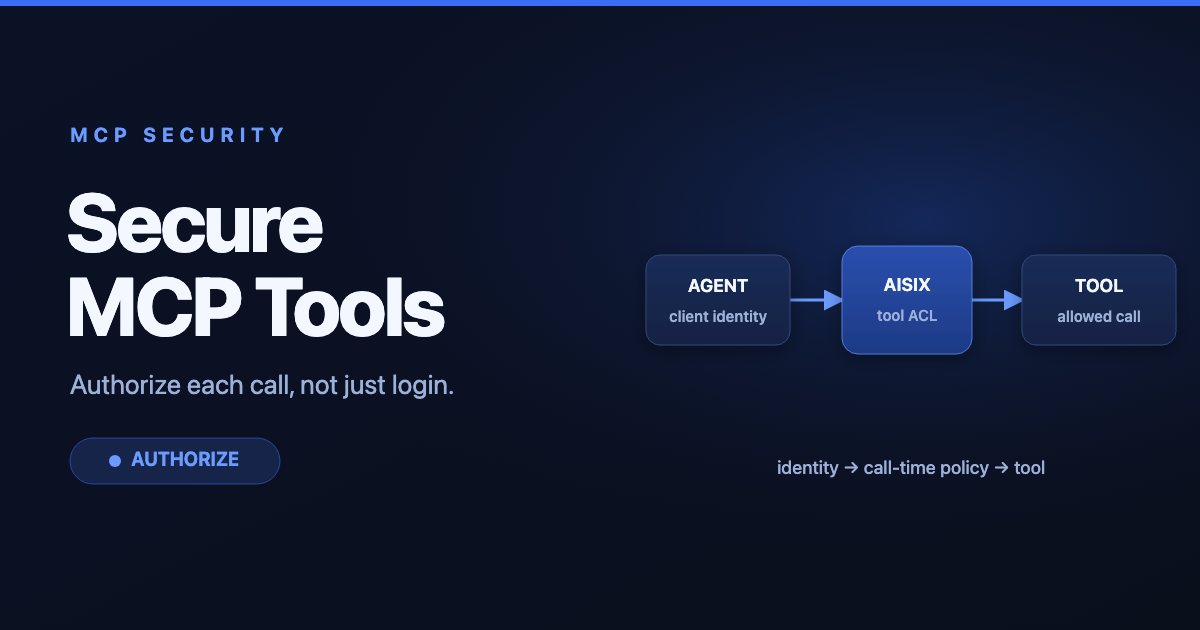
An MCP server can expose capabilities. An AI gateway can help control runtime access to those capabilities. In enterprise environments, both are needed. MCP can make tools available. The gateway can make tool usage governable.
Security Patterns for Agentic AI
AI agent security is not one feature. It is a set of runtime controls.
Least-Privilege Tool Access
Agents should only access the tools they need. A research assistant should not have the same permissions as a deployment agent. A customer support agent should not automatically receive access to finance operations.
The gateway can enforce policies based on agent identity, user identity, tenant, environment, and requested tool.
Separation of Read and Write Actions
Read actions and write actions should be treated differently. Reading a knowledge base is lower risk than updating a customer record. Creating a pull request is lower risk than deploying to production.
An AI gateway can help classify tool calls and apply stricter controls to higher-risk actions.
Audit Logs for Model and Tool Activity
When something goes wrong, teams need to answer practical questions: What did the agent see? Which model did it call? Which tools did it invoke? Which policy allowed the request? How many tokens did it use? Which tenant was affected?
Without centralized logging, that investigation becomes slow and incomplete.
Sensitive Data Controls
Agents may handle customer data, internal documents, credentials, or proprietary context. The gateway can support patterns such as request inspection, redaction, approved provider routing, or blocking requests that violate policy.
The exact controls depend on the organization and product capabilities, but the architectural principle is clear: sensitive data handling should not be implemented differently in every agent.
Observability and Cost Control for Agents
Agent observability is harder than ordinary API observability because one task can produce a chain of actions. A useful observability model should connect:
- user request
- agent session
- model calls
- tool calls
- token usage
- latency
- errors
- policy decisions
- cost
- tenant or team ownership
An AI gateway is well positioned to collect this data because it sits on the runtime path.
Cost control is equally important. Agents can make repeated calls when they fail to complete a task. They can choose expensive models for simple steps. They can retrieve too much context. They can loop through tools. In production, these patterns can create unpredictable spend.
Gateway-level budgets help reduce that risk. Examples include:
- maximum tokens per request
- maximum tokens per session
- model-specific budgets
- tenant-level quotas
- tool-call limits
- fallback to cheaper models for low-risk tasks
- alerting when usage patterns change
These controls let platform teams support agent experimentation without losing operational control.
Enterprise Implementation Checklist
Teams building agentic AI systems should evaluate their gateway strategy early. A practical checklist includes:
- Define agent identities separately from user identities.
- Map which tools each agent can call.
- Separate read-only tools from write-capable tools.
- Route model traffic through a centralized gateway.
- Keep provider credentials out of agent application code.
- Add token budgets and request quotas before broad rollout.
- Log model calls, tool calls, policy decisions, and tenant metadata.
- Decide which workloads can use external providers and which require private or self-hosted models.
- Build fallback behavior for provider failures and throttling.
- Review how MCP servers are exposed and governed.
- Create a clear escalation path for high-risk actions.
This checklist turns agent governance from a design discussion into runtime infrastructure.
Where API7 Fits
API7 AI Gateway can be positioned as the enterprise control layer for agentic AI traffic. The key value is not simply forwarding prompts to model providers. The stronger value is bringing API gateway discipline to AI runtime traffic.
For organizations already using API gateways, service platforms, Kubernetes, multi-cloud infrastructure, or Apache APISIX, this is a natural extension. AI agents are not isolated experiments forever. They become production applications that call APIs, consume budgets, handle sensitive data, and affect business workflows.
API7 can help teams think about AI Gateway as part of the broader API platform:
- AI model traffic and API traffic can be governed together.
- Agent tool calls can follow enterprise access and audit practices.
- Platform teams can manage quotas, routing, and observability centrally.
- Security teams can define policies once instead of reviewing every agent separately.
- Product teams can move faster without bypassing governance.
This is the core message: agentic AI needs freedom to act, but enterprises need control over how that action happens.
Conclusion
AI agents change the shape of application traffic. They call models, tools, APIs, and data sources in dynamic workflows. That makes runtime governance essential.
An AI gateway for agents gives enterprise teams a central place to enforce access control, manage model routing, protect credentials, observe behavior, and control cost. It does not replace agent frameworks or MCP servers. It makes them safer and more operable in production.
If your team is building AI agents that need secure tool access, model routing, observability, and enterprise governance, API7 AI Gateway can help create the runtime control layer between agent innovation and production responsibility.