AI Gateway Compliance Controls: PII, Audit Evidence, and Guardrails

November 26, 2025
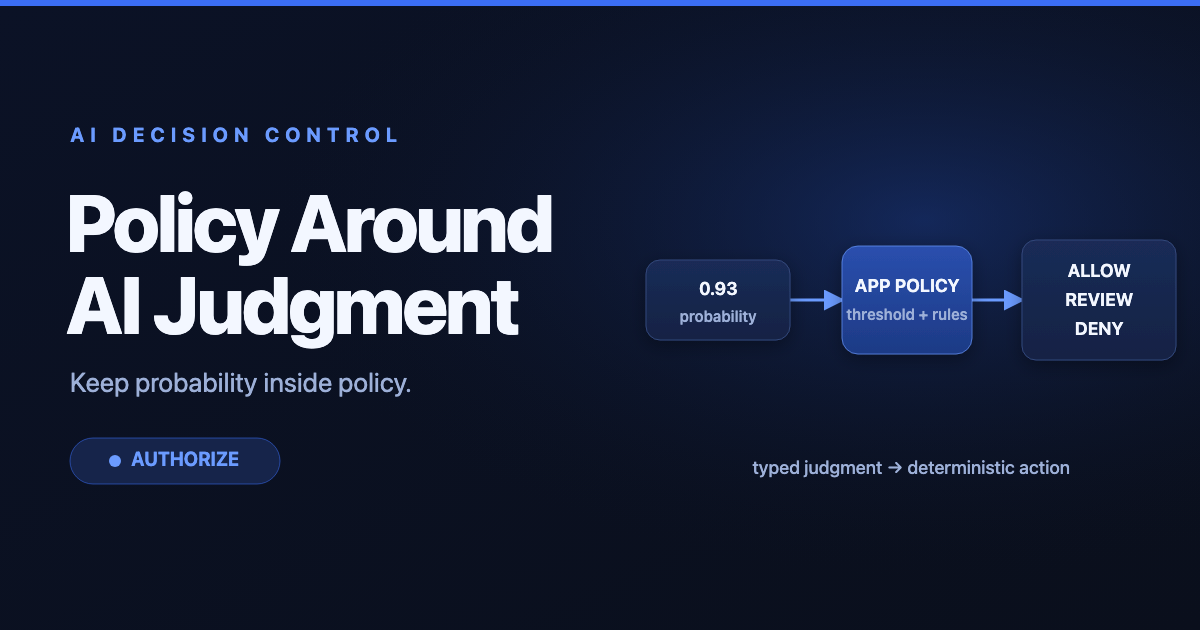
AI gateway compliance controls help teams apply and document technical policy for model traffic. An AI gateway can authenticate callers, restrict model access, enforce token budgets and rate limits, inspect prompts and responses with guardrails, redact sensitive data, and emit evidence for review.
These controls reduce risk and make policy outcomes easier to verify, but they do not make an LLM application automatically compliant. Data purpose, consent, contracts, retention, regional requirements, application authorization, and provider behavior remain part of the wider program.
For identity, provider credentials, least privilege, and layered runtime protection, read AI Gateway Security. This article focuses on compliance-oriented controls and the evidence needed to review them.
Key Takeaways
- Compliance evidence starts with caller identity, model authorization, policy ownership, and explicit data-handling rules.
- Input and output guardrails can block, mask, or observe content according to an explicit policy.
- Prompt-injection and content classifiers are defense-in-depth controls, not proofs that a prompt is safe.
- PII redaction helps reduce data exposure, but teams must also define retention, residency, consent, and provider-processing rules.
- Audit telemetry should be metadata-oriented by default; full prompt and response capture requires a deliberate privacy and retention decision.
AI Gateway Compliance Controls at a Glance
| Control | What It Enforces | Important Limitation |
|---|---|---|
| Caller authentication | Identifies the application, workload, or team making a request | Does not replace end-user or resource-level authorization |
| Model access policy | Restricts which callers can use specific model aliases or tools | Requires accurate identity and policy ownership |
| Rate limits and budgets | Bounds requests, tokens, concurrency, or spend | Limits blast radius but does not classify malicious content |
| Input guardrails | Checks prompt text before the provider call | Detection can produce false positives and false negatives |
| Output guardrails | Checks supported response text before delivery | Streaming may require buffering and add latency |
| PII masking or blocking | Reduces sensitive data sent to providers or callers | Detectors require tuning and cannot replace data governance |
| Telemetry and audit events | Records routing, usage, errors, policy decisions, and guardrail outcomes | Content capture can create additional privacy and security risk |
Why AI Traffic Needs Layered Security
Traditional API controls remain necessary for LLM traffic. A gateway should still verify credentials, protect provider keys, enforce network policy, reject oversized requests, apply rate limits, and record operational telemetry.
AI applications add a second policy surface because prompts and model responses contain unstructured text. A legitimate, authenticated caller can submit content that attempts to override system instructions, disclose protected information, call an unauthorized tool, or consume excessive tokens. The security design therefore needs both layers:
flowchart LR
    Caller[Authenticated caller] --> Access[Identity and model access]
    Access --> Limits[Rate limits and budgets]
    Limits --> Input[Input guardrails]
    Input --> Model[Model provider]
    Model --> Output[Output guardrails]
    Output --> Caller
    Access -.-> Telemetry[Usage and policy telemetry]
    Limits -.-> Telemetry
    Input -.-> Telemetry
    Output -.-> Telemetry
An AI gateway gives platform teams one enforcement point for these shared controls. It does not understand the application's complete business context, so services must still decide whether a user may view a customer record, execute a tool, or perform another sensitive action.
Guardrails for Prompt Injection and Content Policy
Prompt injection attempts to manipulate a model into following untrusted instructions. It can be direct, such as a user asking the model to ignore its system prompt, or indirect, such as malicious instructions embedded in retrieved content.
An AI gateway can run guardrails before a request reaches the provider and, where supported, before a generated response reaches the caller. Common guardrail approaches include:
- literal or regular-expression policies for known forbidden patterns;
- prompt-injection and jailbreak classifiers;
- content-moderation services for categories such as hate, violence, or self-harm;
- tool allowlists and access policy for agent or MCP traffic;
- output checks for policy violations or sensitive text.
Guardrails should first run in monitor mode when the platform supports it. Teams can measure which requests would be blocked or masked, tune the policy, and then move high-confidence rules to enforcement. Detection-based controls should be tested against both malicious examples and legitimate domain language.
Do not rely on phrase matching alone. An attacker can reword instructions, encode text, or place malicious content in retrieved documents. Combine gateway guardrails with constrained tool permissions, application-level authorization, model and provider controls, secure retrieval, human approval for high-impact actions, and continuous testing.
PII Detection and Redaction
Sensitive information can travel in both directions. A prompt may contain an email address, API key, health record, or customer identifier; a response may reproduce data supplied through retrieval or tools.
A PII policy at the gateway can:
- inspect supported request or response text;
- identify configured data patterns or entity types;
- mask the matched value and continue, or block the interaction;
- record the policy outcome without logging the sensitive value itself.
For example, an input policy can replace an email address before the request reaches a model provider:
Before: Summarize the case for alex@example.com.
After:  Summarize the case for [REDACTED_EMAIL].
Redaction is not a complete privacy program. Teams must decide which entity types matter, how custom identifiers are detected, whether a remote guardrail service is allowed to process the text, and what happens when the detector is unavailable. They must also validate behavior for streaming responses and unsupported payload formats.
The focused AI Gateway PII Redaction guide explains data-flow boundaries, failure modes, and validation in more detail. For enforcement behavior across input, output, streaming, monitor, and block modes, see AI Gateway Guardrails.
Auditability Without Creating a New Data Risk
AI traffic needs enough telemetry to answer operational and security questions:
- Which caller and model alias were involved?
- Which provider and model handled the request?
- How many tokens were used, and what did the request cost?
- Did a guardrail match, block, mask, or fail open?
- What status, latency, cache result, and retry path occurred?
This metadata is usually sufficient for dashboards, anomaly detection, cost analysis, and many investigations. Capturing full prompts and responses is a separate decision because that content may contain credentials, personal data, confidential documents, or generated sensitive output.
If content capture is enabled, define access control, encryption, regional storage, retention, deletion, and incident-response procedures before collecting production traffic. Mask sensitive fields before export where possible. An "immutable log of every full prompt" can conflict with data minimization and deletion requirements, so immutability should not be treated as a universal compliance requirement.
Use the AI Gateway Audit Logging guide to design the relationship between request records, policy outcomes, configuration changes, retention, and investigations.
How an AI Gateway Supports Compliance Work
An AI gateway can provide technical evidence and repeatable controls, but compliance depends on the entire system and organization. The gateway can help teams:
- enforce approved model and provider routes;
- apply data-loss prevention and moderation policy;
- separate caller identities and team-level access;
- record policy decisions and model usage;
- apply region-specific routing or provider restrictions;
- demonstrate that traffic controls are deployed consistently.
It cannot decide the lawful basis for processing, obtain consent, validate every model output, or guarantee that a provider meets contractual and regulatory obligations. Security, privacy, legal, and application owners must define the policy that the gateway enforces.
The AI API Governance guide explains how platform teams assign those owners, translate requirements into runtime controls, manage exceptions, and review evidence over time.
Production Implementation Checklist
- Store provider credentials outside application source code and client-visible configuration.
- Authenticate every caller and restrict model or tool access by least privilege.
- Set request, token, concurrency, and budget limits appropriate to each team or workload.
- Start new guardrails in monitor mode and test false-positive and false-negative cases.
- Define input and output coverage, including expected streaming behavior.
- Mask or block sensitive data before it leaves the trusted boundary.
- Decide explicitly whether prompts and responses may be captured.
- Export policy outcomes, latency, token usage, cost, and errors to the observability system.
- Test remote-guardrail timeout behavior and choose fail-open or fail-closed per risk tier.
- Keep business authorization and high-impact action approval in the application workflow.
Place these controls in a broader deployment, migration, and operations workflow with the production AI Gateway rollout guide.
Applying These Controls with AISIX AI Gateway
AISIX AI Gateway provides caller API keys, model access controls, request and token rate limits, guardrails, caching, and observability for model traffic. Response caching applies only to eligible non-streaming chat-completions requests. AISIX Cloud adds managed budgets and centralized usage management.
For MCP and A2A traffic, caller API keys still define access and shared traffic-control boundaries. Request and concurrency limits apply to MCP tools/call and proxied A2A JSON-RPC calls, but not MCP handshakes, tools/list, or agent-card discovery. These calls do not add model tokens to token windows; however, if model traffic has already exhausted a shared key's token window, later tool or agent calls may still be rejected. Guardrails inspect only MCP tools/call arguments and textual results. A2A message content is not currently scanned.
The guardrail behavior documentation explains model-traffic hook points, monitor and block modes, streaming behavior, and failure handling. The MCP guardrail guide documents tool-call coverage. Use the PII guardrail guide to configure masking or blocking, then verify the behavior against representative traffic before production enforcement.
FAQ
Can an AI gateway prevent prompt injection?
It can detect and block some prompt-injection attempts through configured guardrails, but no detector prevents every attack. Use guardrails as one layer alongside constrained tools, authorization, secure retrieval, and application safeguards.
Does an AI gateway make an application compliant?
No. It can enforce and document technical controls, but compliance also depends on data purpose, consent, contracts, retention, access, organizational processes, and the behavior of the application and model providers.
Should an AI gateway log complete prompts and responses?
Not by default. Start with operational and policy metadata. Capture content only when there is a defined need, lawful basis, access model, masking policy, and retention period.
Can PII redaction inspect streaming output?
Some gateways can buffer and inspect streamed output, but this affects latency and requires explicit overflow and failure behavior. Verify the route and guardrail implementation rather than assuming every streaming protocol is covered.
Conclusion
AI gateway compliance controls are most useful when they connect conventional API policy with AI-specific guardrails, careful data handling, and reviewable evidence. Authentication, model access, rate limits, PII controls, prompt and response checks, and telemetry each address a different requirement.
The gateway is the enforcement point, not the entire security or compliance program. Define the policy outside the gateway, configure it explicitly, test it against realistic traffic, and preserve only the telemetry needed to operate and investigate the system responsibly.