AI Gateway Security: Access Control, API Keys, and Sensitive Data Protection

July 14, 2026
Key Takeaways
- AI Gateway security is not just traditional API security with a new name. It must handle model providers, prompts, tokens, agent tool calls, provider credentials, and sensitive data in the same runtime path.
- Direct calls from every application to every model provider make API key rotation, access control, audit trails, and policy enforcement difficult to manage at enterprise scale.
- A secure AI Gateway should separate caller identity from provider credentials, enforce least privilege, protect sensitive data, apply guardrails, and preserve appropriate request and policy evidence.
- Prompt injection, sensitive information disclosure, excessive agency, and unbounded consumption from the OWASP Top 10 for LLM Applications are runtime risks that belong in gateway design discussions.
- AISIX AI Gateway centralizes caller keys, provider credentials, guardrails, rate limits, routing, and runtime telemetry. AISIX Cloud adds managed budgets, usage reporting, and control-plane audit history.
Why AI Gateway Security Is Different from Traditional API Security
Traditional API security protects HTTP APIs from unauthorized access, abuse, injection attacks, excessive traffic, and data leakage. Those controls still matter. In fact, teams building AI applications should keep using strong authentication, authorization, TLS, rate limiting, logging, and threat monitoring. The difference is that AI traffic adds a new layer of runtime context.
An AI request is not only a request to an endpoint. It may include a user prompt, system instructions, retrieved documents, tool definitions, user identity, application metadata, model parameters, and downstream provider credentials. The response may include generated text, structured output, tool calls, code, or content that contains sensitive information. A compromised or over-permissioned AI agent may also call tools and APIs on behalf of a user.
That is why AI Gateway security needs to treat the gateway as a policy enforcement point for AI runtime behavior. The gateway should know who is calling, which application they belong to, which model or provider they are allowed to use, whether the request contains sensitive data, whether the response should be blocked or redacted, and how the request should be logged for audit.
For the broader operating model around routing, rate limits, observability, cost, agents, and MCP traffic, use the AI Gateway Guide as the cluster overview and this article as the security implementation spoke.
For the narrower compliance angle, including PII handling, guardrail evidence, data minimization, and audit records, use AI Gateway Compliance Controls. This keeps security architecture and compliance evidence as separate implementation questions.
The security problem becomes worse when teams let every application call model providers directly. Provider API keys end up scattered across services, CI systems, local development environments, and notebooks. Each team implements its own retries, rate limits, logging, redaction, and moderation. Security teams lose a consistent place to ask basic questions: Which apps used which model? Which user triggered a blocked prompt? Which provider key was rotated? Which tenant generated the most risky requests?
A gateway does not remove the need for application security or model evaluation. It gives the organization a runtime control plane where common AI traffic policies can be applied consistently.
Core Security Controls for an AI Gateway
Caller Authentication and API Key Lifecycle
The first control is caller identity. An AI Gateway needs to know which application, service, user, team, or tenant is making the request. API keys are still common for service-to-service calls, and API7 has existing educational content on what an API key is and the disadvantages of API keys. For AI traffic, the important point is lifecycle management: issue keys with clear ownership, scope them to specific environments and applications, rotate them, expire them, disable them quickly, and log their use.
Caller API keys should not be confused with provider API keys. A caller key identifies the internal application or tenant using the gateway. A provider key authenticates the gateway to OpenAI, Anthropic, Azure OpenAI, Gemini, Bedrock, or another model endpoint. Mixing these two concepts is a common design mistake because it pushes provider secrets into every application.
With AISIX caller API keys, teams can treat caller identity as part of the gateway policy model. The gateway can then apply model access, rate limits, and runtime telemetry based on the calling app or tenant. AISIX Cloud can additionally apply managed budgets at documented scopes.
Provider Credential Isolation
Provider credentials should be centrally managed and isolated from application code. Applications should call the gateway with their own identity, and the gateway should select the correct provider credential based on policy. This makes provider rotation much safer. If a provider key is compromised, the platform team rotates it at the gateway layer instead of searching across every service repository and deployment environment.
Provider credential isolation also enables stronger tenancy boundaries. One team may be allowed to use an OpenAI production key for customer-facing workloads, while another team uses a lower-cost development provider for experiments. A regulated workflow may require a provider deployed in a specific region. These decisions should not rely on developers copying the right environment variable into every application.
AISIX documents provider keys as a first-class gateway concern. That is the right model for enterprise AI systems: applications send AI requests through a controlled path, and the platform manages the provider side.
Authorization by App, Tenant, Model, and Tool
Authorization for AI traffic needs more dimensions than a normal endpoint allowlist. A policy may need to answer questions such as:
| Policy dimension | Example security question |
|---|---|
| Caller | Is this app allowed to use production models? |
| Tenant | Is this tenant allowed to send data to this provider? |
| Model | Can this workload use a high-cost reasoning model? |
| Endpoint | Is image generation allowed, or only chat completions? |
| Tool | Can this agent call a payment, database, or deployment tool? |
| Environment | Is this key valid only in staging? |
These rules become even more important with agents and MCP tools. The Model Context Protocol security best practices emphasize the need to control tool permissions, user consent, and trust boundaries. An AI Gateway can support that operating model by enforcing access control before a tool call or provider call leaves the organization.
Sensitive Data Detection and Protection
AI requests often contain customer messages, support tickets, financial data, health information, source code, logs, or internal documents. Sensitive data protection should be explicit rather than accidental. A gateway policy may block the request, redact selected fields, mask data before forwarding to a model, or allow the request but increase logging and review.
The OWASP LLM Top 10 calls out sensitive information disclosure as a major risk for LLM applications. This risk can appear in both directions: users may send sensitive information to a model, and models may disclose sensitive information in responses. Gateway-side detection is useful because it sees the request and response across applications.
AISIX AI Gateway includes guardrails, including policy patterns for PII and content filtering. Guardrails should be treated as layered defense. They reduce risk, create a central audit point, and help teams respond faster, but they do not remove the need for data classification, secure retrieval, application authorization, and human review for high-risk workflows.
Reference Architecture: Secure AI Traffic Through a Gateway
flowchart LR
    App[AI application or agent] --> Gateway[AISIX AI Gateway]
    Gateway --> Auth[Caller identity and access policy]
    Gateway --> Guardrails[Prompt, PII, and response guardrails]
    Gateway --> Routing[Model routing and provider selection]
    Routing --> Provider[Model provider]
    Gateway --> Logs[Audit logs, usage, cost, and policy results]
    Logs --> SecOps[Security and platform review]
In this architecture, the application never stores provider credentials. It authenticates to the gateway as a caller. The gateway checks whether the caller can use the requested model, endpoint, or tool. Guardrails inspect requests and responses. Routing policies select the provider or model alias. Logs preserve the evidence needed for operations, compliance, and incident response.
The gateway should retain enough context to support investigations without storing unnecessary sensitive content. Useful evidence can include caller identity, application, tenant, environment, route, requested model, selected provider, token usage, status code, latency, guardrail result, policy decision, and error details. AISIX provides documented metrics and usage events; AISIX Cloud adds managed usage reporting and logging and auditing.
How AISIX Helps Secure AI Gateway Traffic
AISIX AI Gateway is designed for organizations that need runtime control over AI traffic rather than a thin proxy to a model provider. The gateway handles routing, traffic controls, caller and provider credentials, model aliases, guardrails, and runtime telemetry. AISIX Cloud adds managed usage views, budgets, and audit history.
This matters because enterprise AI security is an operating model. The platform team wants consistent traffic control. The security team wants access control, audit trails, and sensitive data protection. Developers want an OpenAI-compatible or provider-compatible path that does not force every service to implement the same security code. Finance wants cost attribution. SRE wants latency, errors, retries, and fallback visibility.
API7 is also grounded in the API gateway world. The broader API7 and Apache APISIX ecosystem already covers authentication, authorization, rate limiting, observability, traffic management, and plugin-based extension. That background is valuable because AI Gateway security should not be separated from the rest of API security. AI applications still call APIs, expose APIs, and depend on service reliability.
Conclusion
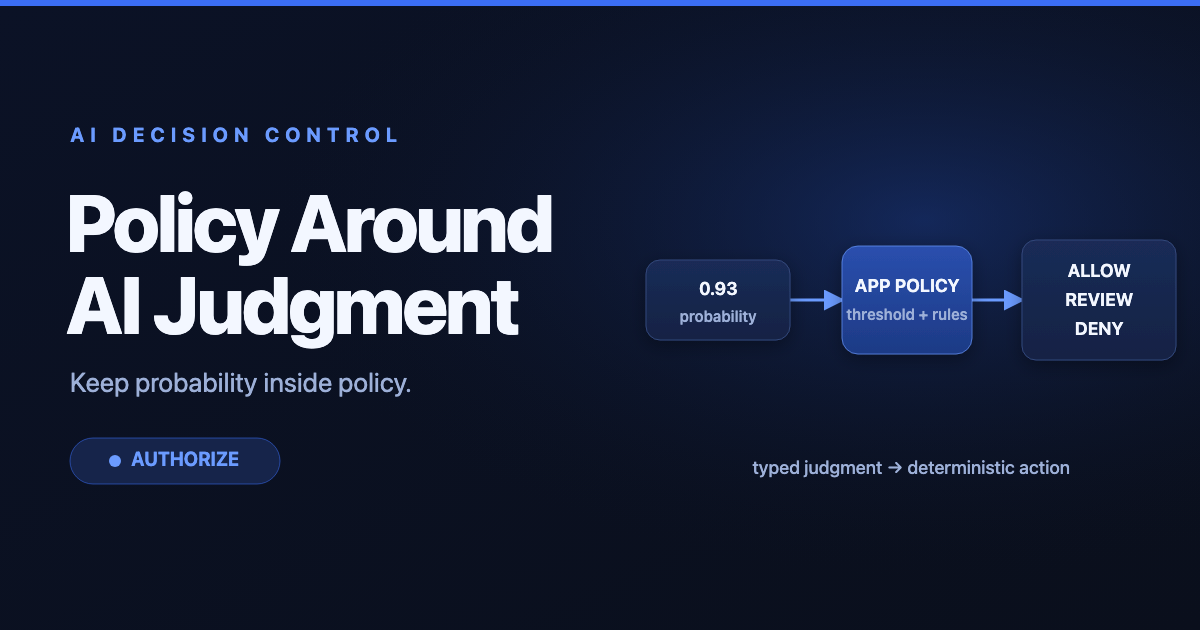
AI Gateway security should be treated as a runtime control layer for production AI systems. It should authenticate callers, isolate provider credentials, enforce access policies, protect sensitive data, apply guardrails, preserve audit logs, and connect security decisions to usage, cost, and reliability signals.
No gateway can make LLM applications risk-free. Prompt injection, sensitive information disclosure, excessive agency, and provider behavior require layered defenses across application code, data access, model evaluation, human review, and security operations. But without a gateway, every team must rebuild those controls in its own application. That creates inconsistent policy and weak visibility.
If your organization is moving from experiments to production AI applications, explore AISIX AI Gateway and the related documentation for caller API keys, provider keys, guardrails, and logging and auditing. Start with a narrow path, make it observable, and then expand the control plane as AI traffic grows.