How API7 Gateway Overcomes Exceptions with High Availability Strategies

April 8, 2024
High availability is an important design goal for API gateway deployments. Gateways handle request routing between applications and services, but end-to-end availability must account for the gateway topology, network, upstream services, and operations.
This article examines API7 Enterprise, an enterprise API management platform built on Apache APISIX, and the data-plane mechanisms intended to reduce the impact of control-plane or network exceptions. Availability outcomes still depend on the customer-managed deployment and its infrastructure.
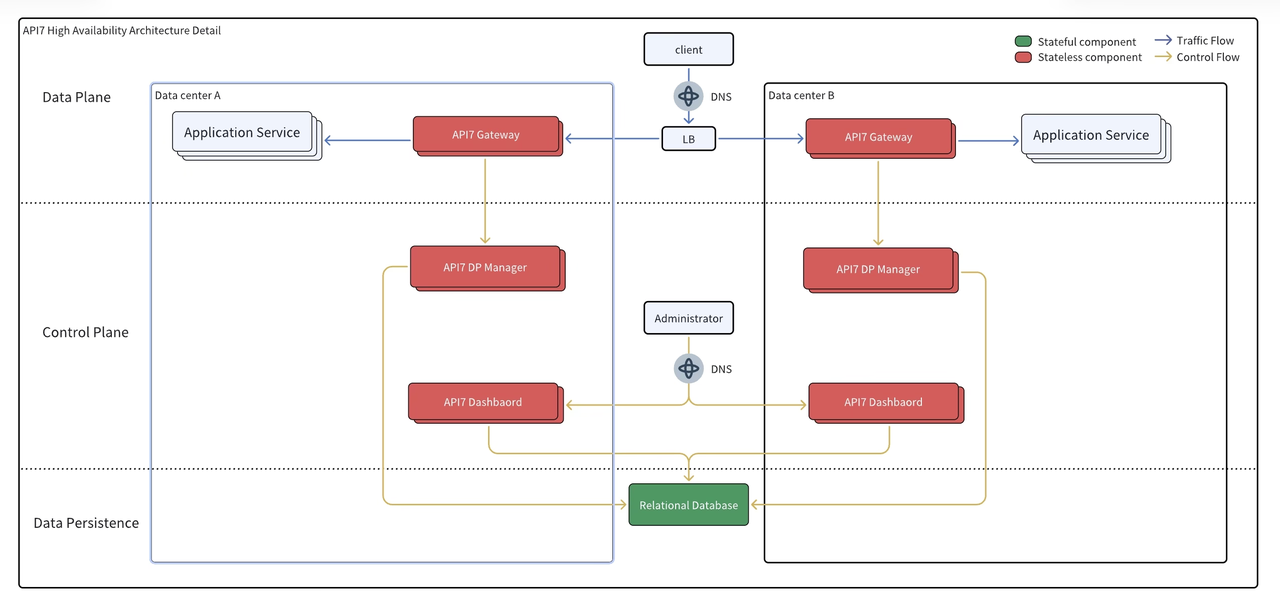
Enterprise-level High Availability Architecture
As discussed in API7 enterprise high-availability solutions, stateless components can support fault recovery and resource scheduling. These design characteristics can improve resilience, but the availability achieved in production depends on the customer’s topology, infrastructure dependencies, and operations.
High Availability Strategies of API7 Enterprise
Building on Apache APISIX, API7 Gateway uses configuration-recovery mechanisms intended to preserve a usable configuration and reduce interruption risk during exceptional conditions. They operate in three phases:
-
Configuration recovery at startup;
-
Full configuration synchronization and local storage;
-
Dynamic configuration changes and persistence.
These are designed to address the extreme circumstances of the data plane's inability to connect to the control plane due to significant uncertainties (such as DNS, network, control plane, etc.).
Configuration Recovery at Startup
If the control-plane connection fails when an API7 Gateway instance starts, the gateway attempts to retrieve the latest configuration from local storage. A valid local snapshot can help the instance resume routing with the previous configuration; successful recovery still depends on that snapshot and the surrounding infrastructure.
In more extreme cases, you can change the instance's local configuration files, which can be used as API7 Gateway's startup configuration.
Full Configuration Synchronization and Local Storage
After connecting to the configuration center, API7 Gateway synchronizes configuration information and stores it as JSON in the local file system. During a later connection interruption, a running gateway can use its in-memory or local configuration, subject to the validity of that configuration and other deployment dependencies.
Dynamic Configuration Changes and Persistence
When the control plane pushes a configuration update, API7 Gateway applies the change and updates the local configuration file. This persistence can shorten recovery after a restart, but it does not eliminate every possible service interruption.
Designs for Handling Extreme Situations
API7 Gateway includes configuration persistence and recovery logic for conditions such as network isolation, control-plane failure, and local resource constraints. These mechanisms can improve gateway resilience; end-to-end business continuity also depends on redundant data-plane capacity, load balancing, upstream services, and customer operations.
Conclusion
Configuration recovery, synchronization, local storage, and persistence can help API7 Gateway continue using the last available configuration during control-plane unavailability or instance restarts. The result depends on the customer-managed architecture and operations and does not constitute an uptime commitment for API7 Enterprise.
API7 Enterprise provides high-availability mechanisms for customer-managed deployments. These mechanisms can reduce failure impact, but achieved service availability depends on the customer's deployment architecture, infrastructure dependencies, and operations.