Are Edge Workers Killing the API Gateway? The Real Reason OpenWorkers is Trending
January 6, 2026
Over the past few days, a vital discussion has taken over Hacker News, sparked by a single project: "Show HN: OpenWorkers – Self-hosted Cloudflare workers in Rust." Developers are engaged, and it's easy to see why. The project taps into a core desire for control, freedom from vendor lock-in, and the benefit of predictable costs. It champions a world where you can run serverless functions on your own terms.
The excitement is clear. But it also raises a critical question: in a world of powerful, self-hosted edge runtimes, is the traditional API gateway becoming obsolete? The frustration with vendor-controlled platforms is real. Cloud functions can be expensive, opaque, and restrictive. But declaring the API gateway obsolete is a step too far. OpenWorkers and similar runtimes excel at code execution, but they don't solve the broader, more complex challenge of traffic management.
This post will break down what edge workers do well, where a full-featured API gateway is still essential, and how both fit into a modern, scalable architecture. We'll show you how to get the best of both worlds by pairing the philosophy of OpenWorkers with the enterprise-grade power of API7, built on the high-performance open-source API gateway, Apache APISIX.
What Are Self-Hosted Edge Workers and Why Are They Trending?
A long-standing pain point for developers has been the trade-off between the convenience of serverless and the control of self-hosting. Traditional serverless platforms abstract away infrastructure, but often at the cost of flexibility and budget. As applications scale, per-request pricing can become a significant financial burden.
Self-hosted edge workers, like the concept embodied by OpenWorkers, were designed to address this issue. They provide a runtime environment—often leveraging technologies like V8 isolates and Rust for performance and security—that allows you to run sandboxed functions on your own infrastructure. Instead of being locked into a specific cloud provider's ecosystem, you regain sovereignty over your stack.
When Claude begins a task, it first performs a lightweight scan of all available Skills by reading only their YAML metadata. This progressive disclosure allows for efficient initialization. Similarly, OpenWorkers provides a lean runtime that executes JavaScript in V8 isolates with minimal overhead. The architecture is clean and focused on one thing: running code safely and efficiently.
Here's what a typical OpenWorkers deployment looks like:
// worker.js
export default {
  async fetch(request, env) {
    const data = await env.KV.get("key");
    const rows = await env.DB.query("SELECT * FROM users WHERE id = $1", [1]);

    return new Response(JSON.stringify({ data, rows }), {
      headers: { "Content-Type": "application/json" }
    });
  }
};
This approach allows developers to deploy discrete, stateless logic with high efficiency. It's a model that resonates strongly with the DevOps and open-source communities, but it's only one piece of the architectural puzzle.
The Architectural Gap: From Single Functions to Distributed Systems
A worker-only architecture is clean and simple for a small number of functions. However, as an application grows into a distributed system with dozens or hundreds of services, this model reveals its limitations. Each client application is forced to know about every individual worker and service, and cross-cutting concerns like authentication, rate-limiting, and monitoring become a decentralized nightmare.
This architectural difference is stark when visualized:
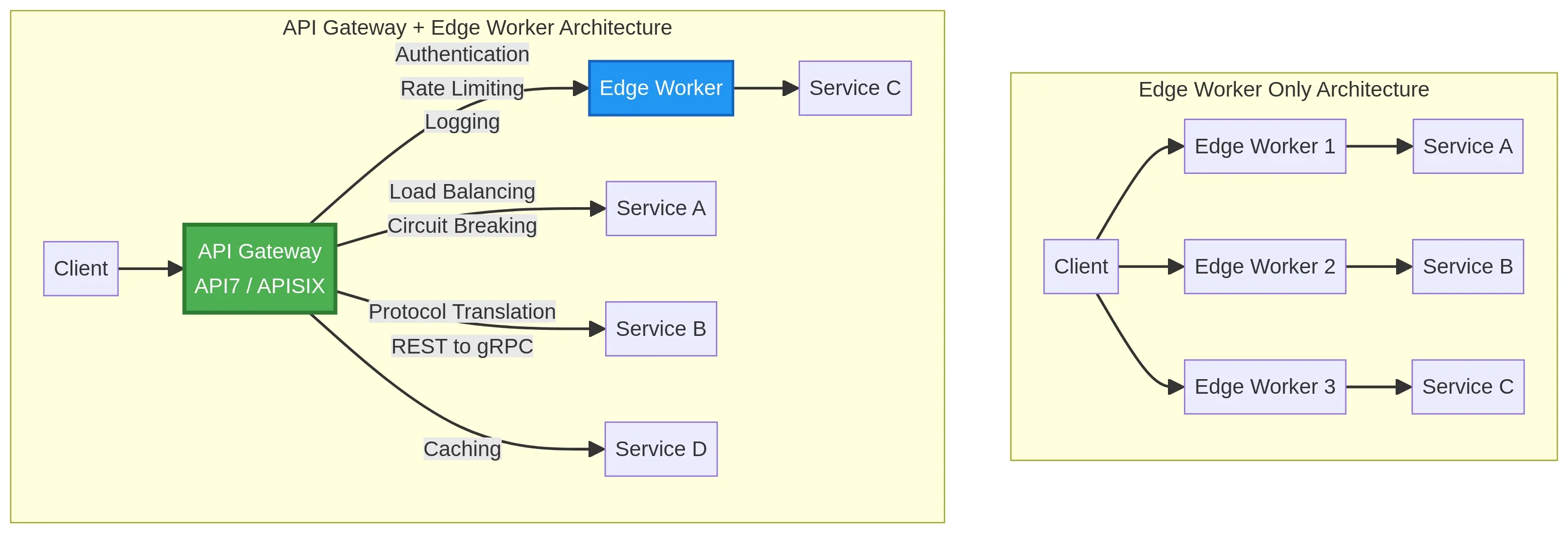
In the "Edge Worker Only" model on the right, the client is burdened with complexity. Every client needs to:
- Maintain a list of all available services and workers
- Implement authentication logic for each service
- Handle retry logic and circuit breaking independently
- Aggregate logs and metrics from multiple sources
In the "API Gateway + Edge Worker" model on the left, the API gateway acts as a unified entry point, simplifying the client and centralizing critical policies. The gateway becomes the single source of truth for routing, security, and observability.
How Edge Workers Compare to a Full API Gateway
Today's application architecture landscape can feel crowded. Now that we understand the value of edge workers, we need to see how they relate to another critical component: the API gateway. While they can seem similar, they solve fundamentally different problems.
An edge worker answers the question, "How and where should this specific piece of code execute?"
An API gateway answers the question, "How should all my services communicate securely, reliably, and efficiently?"
Here is a detailed comparison of their distinct roles:
| Dimension | Self-Hosted Edge Worker (e.g., OpenWorkers) | API Gateway (e.g., API7 / Apache APISIX) |
|---|---|---|
| Core Value | Provides a sandboxed runtime for executing functions on your own infrastructure. | Provides a centralized control plane for managing, securing, and observing all API traffic. |
| Primary Function | Code Execution | Traffic Management |
| Authentication | Basic, often requiring custom implementation per function. | Rich, out-of-the-box support for OIDC, JWT, LDAP, Key Auth, mTLS, and more. |
| Rate Limiting | Per-function implementation, no global view. | Centralized rate limiting across all services with multiple strategies (fixed window, sliding window, token bucket). |
| Observability | Basic logging capabilities, requires custom aggregation. | Integrated, production-grade logging, metrics (Prometheus), and distributed tracing (OpenTelemetry, Zipkin, Jaeger). |
| Traffic Control | Simple service bindings. | Advanced strategies like canary releases, blue-green deployments, traffic splitting, mirroring, and A/B testing. |
| Protocol Support | Primarily HTTP-based. | Native support for HTTP/HTTPS, gRPC, WebSockets, QUIC, MQTT, TCP/UDP, and custom L4/L7 protocols. |
| Security | Sandboxing for code execution. | Deep defense with WAF, IP/Geo-restriction, bot detection, request validation, and CORS management. |
| Caching | Limited, per-function cache. | Distributed caching with Redis integration, cache invalidation strategies, and cache key customization. |
| Service Discovery | Manual configuration. | Dynamic service discovery with Consul, Eureka, Nacos, and Kubernetes integration. |
| Deployment | Function-level deployment. | Zero-downtime configuration updates, hot-reload, and version management. |
Let's take a modern e-commerce application as an example.
-
Edge Worker: A function that resizes a product image on-the-fly, validates a coupon code, or performs a simple data transformation could be a perfect job for an edge worker. It's a discrete, stateless task that benefits from low latency.
-
API Gateway: The gateway would handle the entire user journey. It would authenticate the user's login request, route product searches to the
product-service, send the checkout request to thepayment-service, apply rate limiting to prevent abuse, log every transaction for analytics, and protect the entire system from malicious attacks with a Web Application Firewall.
An edge worker is a powerful tool for specific tasks, but an API gateway is the central nervous system that makes the entire application function as a cohesive whole.
Building a Production-Ready API Gateway with Apache APISIX
With an API gateway like Apache APISIX, defining a route is a simple, dynamic API call. There's no need for complex service discovery on the client or redeploying workers to change routing logic. The configuration is applied instantly without any service interruption.
Example 1: Basic Routing with Load Balancing
Here is how you would create a basic route in APISIX to direct traffic from /api/products to your backend services with round-robin load balancing:
curl -i "http://127.0.0.1:9180/apisix/admin/routes/1" \
  -X PUT \
  -H 'X-API-KEY: <your-apisix-api-key>' \
  -H 'Content-Type: application/json' \
  -d '{
  "id": "1",
  "uri": "/api/products/*",
  "upstream": {
    "type": "roundrobin",
    "nodes": {
      "product-service-1.internal:8080": 1,
      "product-service-2.internal:8080": 1,
      "product-service-3.internal:8080": 1
    },
    "timeout": {
      "connect": 6,
      "send": 6,
      "read": 6
    }
  }
}'
Example 2: Adding Authentication and Rate Limiting
Now let's add JWT authentication and rate limiting to protect this route:
curl -i "http://127.0.0.1:9180/apisix/admin/routes/1" \
  -X PUT \
  -H 'X-API-KEY: <your-apisix-api-key>' \
  -H 'Content-Type: application/json' \
  -d '{
  "id": "1",
  "uri": "/api/products/*",
  "plugins": {
    "jwt-auth": {
      "key": "user-key",
      "secret": "my-secret-key",
      "algorithm": "HS256"
    },
    "limit-count": {
      "count": 100,
      "time_window": 60,
      "rejected_code": 429,
      "rejected_msg": "Too many requests",
      "policy": "local"
    }
  },
  "upstream": {
    "type": "roundrobin",
    "nodes": {
      "product-service-1.internal:8080": 1,
      "product-service-2.internal:8080": 1,
      "product-service-3.internal:8080": 1
    }
  }
}'
Example 3: Canary Deployment with Traffic Splitting
One of the most powerful features of an API gateway is the ability to implement sophisticated deployment strategies. Here's how to set up a canary deployment that sends 90% of traffic to the stable version and 10% to the new version:
curl -X PUT 'http://127.0.0.1:9180/apisix/admin/routes/1' \
  -X PUT \
  -H 'X-API-KEY: <your-apisix-api-key>' \
  -H 'Content-Type: application/json' \
  -d '{
  "id": "1",
  "uri": "/api/products/*",
  "plugins": {
    "traffic-split": {
      "rules": [
        {
          "weighted_upstreams": [
            {
              "upstream": {
                "name": "product-service-stable",
                "type": "roundrobin",
                "nodes": {
                  "product-service-v1.internal:8080": 1
                }
              },
              "weight": 90
            },
            {
              "upstream": {
                "name": "product-service-canary",
                "type": "roundrobin",
                "nodes": {
                  "product-service-v2.internal:8080": 1
                }
              },
              "weight": 10
            }
          ]
        }
      ]
    }
  }
}'
Example 4: Protocol Transcoding (REST to gRPC)
Modern microservices often use different protocols. APISIX can seamlessly transcode between them. Here's an example of exposing a gRPC service via a REST API:
curl -X PUT 'http://127.0.0.1:9180/apisix/admin/routes/1' \
  -X PUT \
  -H 'X-API-KEY: edd1c9f034335f136f87ad84b625c8f1' \
  -H 'Content-Type: application/json' \
  -d '{
  "id": "1",
  "uri": "/api/users/:id",
  "methods": ["GET"],
  "plugins": {
    "grpc-transcode": {
      "proto_id": "1",
      "service": "UserService",
      "method": "GetUser"
    }
  },
  "upstream": {
    "scheme": "grpc",
    "type": "roundrobin",
    "nodes": {
      "user-grpc-service.internal:50051": 1
    }
  }
}'
These examples demonstrate capabilities that are far beyond the scope of a simple worker runtime. They represent the difference between running code and orchestrating a production system.
The Power of Open Source: No Vendor Lock-In
Both OpenWorkers and Apache APISIX share a fundamental philosophy: open source and no vendor lock-in. Apache APISIX is a top-level Apache Software Foundation project, which guarantees it will always remain open and community-driven. API7 Enterprise is built on this foundation, offering enterprise-grade features and support without ever locking you into a proprietary ecosystem.
This means you can:
- Deploy on any infrastructure (AWS, GCP, Azure, on-premises, or hybrid)
- Modify and extend the codebase to fit your specific needs
- Contribute back to the community and benefit from collective innovation
- Avoid the risk of a single vendor controlling your critical infrastructure
Conclusion: Build for Today, Architect for Tomorrow
The debate isn't about edge workers versus API gateways. It's about using the right tool for the right job and understanding how they complement each other. The excitement around self-hosted runtimes like OpenWorkers is a clear indicator that developers want more control and less lock-in. An open-source API gateway like Apache APISIX is the logical extension of that philosophy, providing the architectural backbone needed for security, scalability, and governance.
By pairing the flexibility of an edge worker with the power of an enterprise-grade API gateway, you create a future-proof stack that is ready to scale. You get the freedom developers crave and the production-ready capabilities businesses need.
As you explore the potential of modern application architectures, API7 Enterprise stands as a critical tool for managing and scaling your services. By pairing a powerful API gateway with your development workflows, you can improve not only your operational efficiency but also the speed and reliability of your applications.
Ready to build the future of APIs?
Have questions or want a deep dive on any feature? Join our community to chat with our engineers and other developers building with Apache APISIX. You can also talk to API7 experts to get a demo.
More Resources
- API7 Plugin Hub
- API7 Demo Hub
- API Gateway Comparison
- Learning Center: API 101 and API Gateway Guide