Forward Proxy Explained: How It Works and Common Uses
January 12, 2024
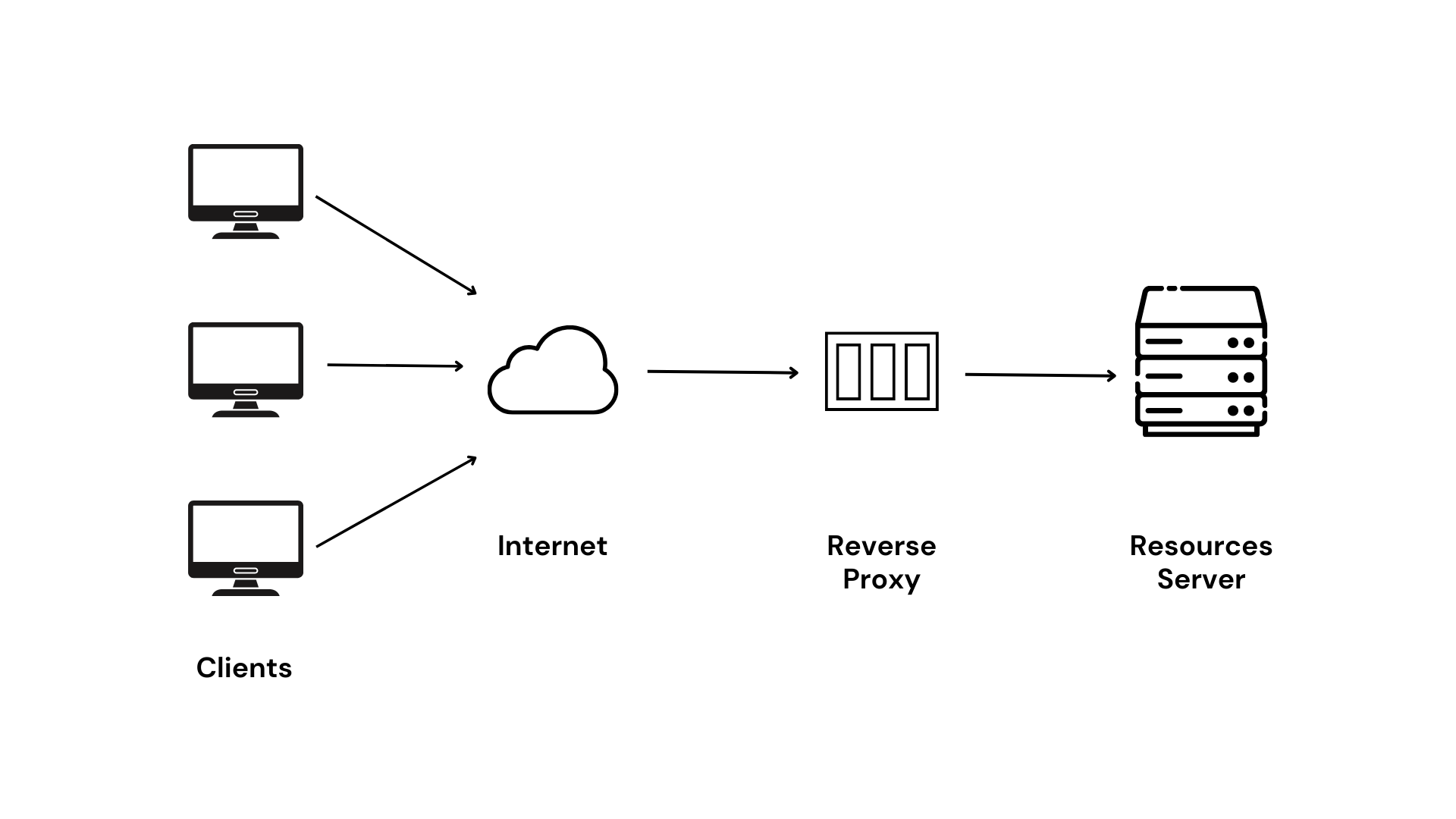
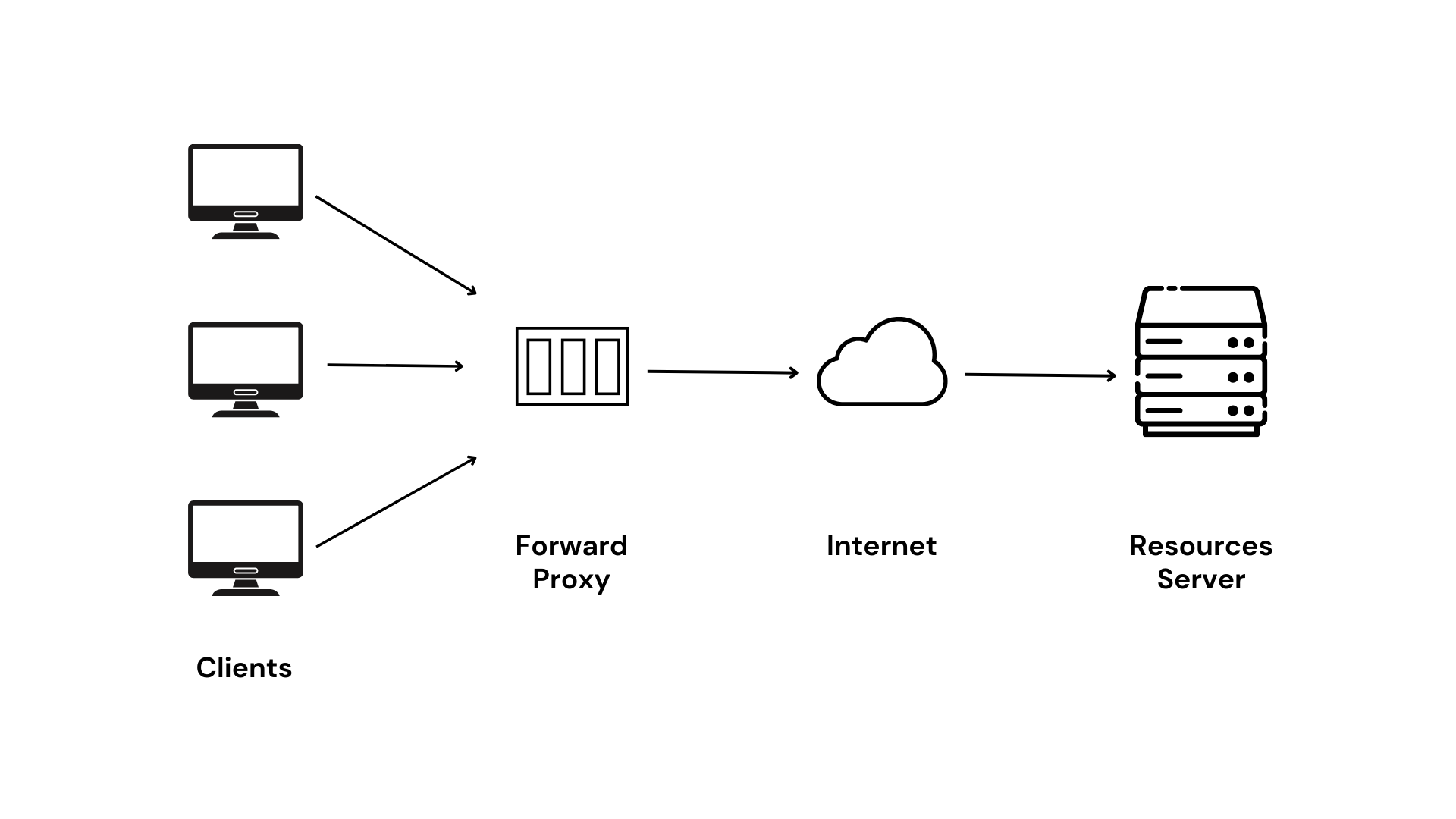
A forward proxy is an intermediary that sends requests to internet services on behalf of clients. Organizations use it to control outbound access, apply content filtering, log traffic, cache suitable content, and keep internal client addresses from being exposed directly to destination servers.
Unlike a reverse proxy, which protects backend servers and accepts traffic on their behalf, a forward proxy represents the client. The client or its network is configured to send traffic through the intermediary before it reaches the destination.
What Is a Forward Proxy?
When a client sends a request through a forward proxy, the proxy receives the request, applies any configured policy, opens a connection to the destination server, and relays the response. The destination generally sees the proxy's network address rather than the client's internal address.
| Use Case | What the Proxy Does |
|---|---|
| Outbound access control | Allows or blocks access by user, destination, protocol, or policy |
| Content filtering | Inspects permitted request metadata and blocks disallowed destinations |
| Network security | Logs outbound traffic and provides a control point for detecting abuse |
| Caching | Reuses cacheable responses to reduce repeated downloads and upstream load |
| Stable egress | Sends requests from a known IP address that a partner can allowlist |
A proxy is one layer of a defense-in-depth strategy. It does not replace endpoint protection, TLS certificate validation, or controls designed specifically for denial-of-service attacks.
From the OSI Model to Proxy Servers
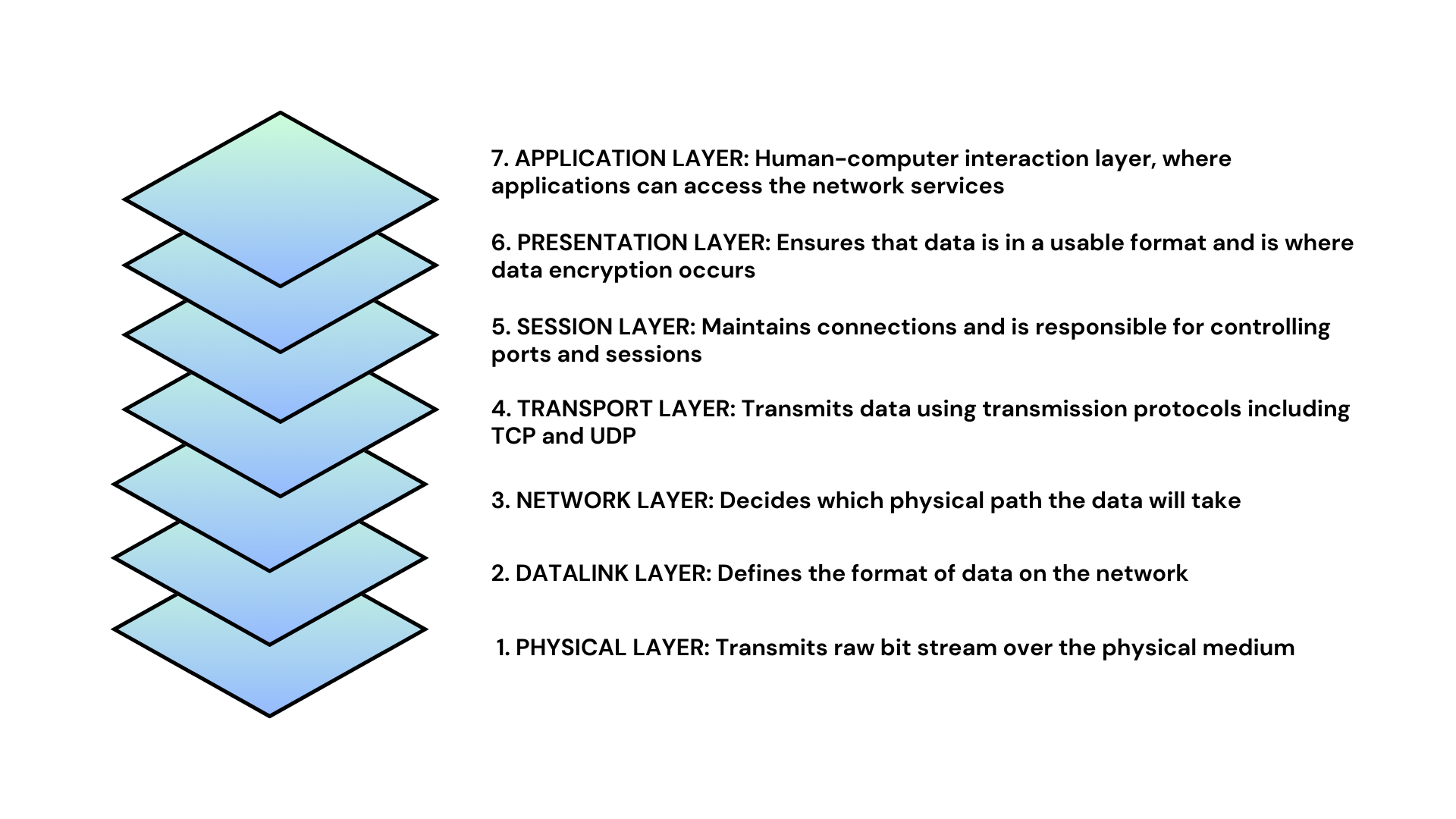
When accessing internet services, we typically employ the HTTP protocol, operating at the layer 7 of the OSI model. Familiar components of this protocol, such as hostnames, paths, and query parameters, are parts of this layer. The HTTP protocol is built upon TCP or UDP protocols, functioning at the layer 4 of the OSI model, and the concepts of ports used during service access exist within these protocols. Going further, both TCP and UDP are based on the Internet Protocol (IP), operating at the layer 3 of the OSI model, where IP addresses serve as the internet's "house numbers".
When using an IP network to access the internet, the IP protocol is responsible for addressing the target, encapsulating data packets according to rules, and forwarding them from the source address to the destination address within the IP network. For instance, network traffic travels from a visitor's local network through the ISP-provided gateway device, connecting to the ISP's network before accessing the services of a resource provider.
At this point, we use a gateway to access the internet. A proxy plays a similar intermediary role at the application layer or for specific transport connections. HTTP proxies interpret application-layer requests, while SOCKS proxies relay lower-level connections. It is therefore more useful to describe a proxy by the protocol it understands than to assign every proxy to a single OSI layer.
Purposes of Proxy Servers
Common uses include the following:
- Centralized Exit for Internal Network Access
Enterprises often have certain information security requirements, such as access control and traffic logging. With the prevalence of encrypted traffic like HTTPS, concealing network traffic beneath passwords makes it challenging to record and audit at the network boundary, increasing the risk of leaks. The existence of a proxy server serves as a unified traffic exit, acting as an intermediary to handle traffic auditing tasks.
Besides human-oriented purposes, proxy services can also serve as an exit for programmatic services accessing the external network. For example, when a service provider offers webhook functionality, it needs to channel traffic through a fixed exit, using a single fixed IP address or a range of fixed IP addresses. This facilitates the recipient of webhook calls to correctly whitelist them in the firewall. Failure to do so exposes both sides of webhook calls to potential security risks.
- Concealing Visitor Identity
At times, internet users may wish to avoid exposing their source IP address directly to a destination. The client connects to the intermediary and specifies the service it wants to reach. With an HTTPS tunnel, TLS normally remains end to end between the client and destination, so a tunneling proxy relays encrypted bytes without reading the application data. A proxy that performs TLS inspection is different: it terminates and re-establishes TLS and must be explicitly trusted by the client.
HTTP-Based Proxy
Two common options are HTTP proxies and SOCKS4 or SOCKS5 proxies. They serve similar intermediary roles but operate differently. The following sections focus on HTTP-based proxies.
In the early stages of protocol implementation, traffic on HTTP was primarily plaintext. This transparency allowed proxy servers in the middle of the client and service to effortlessly parse URLs and request payloads. Through DNS resolution and similar processes, the proxy could connect to the service using its own network address, thereby concealing the client.
An example of such a call is as follows:
GET http://example.com/resource HTTP/1.1
Proxy-Authorization: Basic encoded-credentials
The proxy server understands the address the client is attempting to access and sends a request to the service to obtain a response, which is then returned to the client.
HTTP/1.1 200 OK
Content-Type: text/html
...
body blahblah
...
This represents the simplest implementation form of an HTTP proxy server. However, we observe drawbacks: the proxy server handles client traffic in plaintext, posing a potential security risk as it might record user traffic during forwarding. Therefore, the consideration of encryption methods is necessary to ensure security.
Complex Workings of HTTPS Traffic and Proxy Servers
With the increase in the proportion of HTTPS encrypted traffic within all HTTP traffic, proxy servers must adapt to this scenario.
However, a challenge arises: the traffic sent by the client to the service provider is now encrypted. The proxy server cannot understand what resource the client is accessing through decryption. This is because the traffic is protected by a key negotiation mechanism based on asymmetric encryption algorithms between the client and the service provider, and subsequent encrypted traffic uses symmetric keys that cannot be obtained by a man-in-the-middle during communication. The fundamental purpose of TLS is to prevent the possibility of man-in-the-middle attacks.
So, how does the proxy server work in this case?
This is more complex compared to the previous method of plaintext request parsing. The HTTP protocol introduced a dedicated request method CONNECT. The client uses this method to send an initial request to the proxy server:
CONNECT server.example.com:443 HTTP/1.1
Host: server.example.com:443
Proxy-Authorization: Basic encoded-credentials
The client sends a CONNECT request containing the destination host and port. If policy allows the connection, the proxy opens a TCP connection to the target and relays bytes between the two connections. The client then performs the TLS handshake with the destination through that tunnel. Security still depends on normal certificate validation and on whether the client trusts the proxy configuration.
This mechanism, compared to plaintext HTTP proxies, is more versatile. Once the first HTTP request informs the proxy server of the information to establish a connection, it essentially becomes a transparent proxy channel. It can facilitate communication for both HTTPS and TCP binary traffic (such as SSH) through the proxy server.