AI Gateway for Multi-Cloud and Hybrid LLM Traffic

August 4, 2026
Key Takeaways
- Multi-cloud AI is a policy and operating-model problem, not simply a list of model providers behind fallback.
- Applications should use stable model aliases and caller identities. Cloud-specific endpoints, model IDs, credentials, and authentication belong behind the gateway boundary.
- A central gateway is simple, regional gateways reduce latency and isolate failures, and on-premises gateways keep private-model and regulated traffic inside controlled infrastructure.
- Data residency must constrain routing and failover. A healthy model in another region is not an acceptable fallback when policy prohibits the request from crossing that boundary.
- Unified telemetry should preserve both the alias requested by the application and the provider/model that actually served each attempt.
- AISIX AI Gateway supports public providers, cloud AI platforms, and private OpenAI-compatible endpoints through one gateway runtime and multiple deployment options.
Enterprise AI rarely stays with one provider. A team may begin with an OpenAI account, add Azure OpenAI for an existing Microsoft agreement, use Amazon Bedrock for models close to AWS workloads, evaluate Gemini on Vertex AI, and deploy a private vLLM endpoint for sensitive or predictable workloads.
That portfolio can improve model choice, resilience, negotiation leverage, and regional coverage. It can also create a fragmented application layer in which every service owns provider SDKs, credentials, model IDs, retries, quotas, logs, and compliance decisions.
A multi-cloud AI Gateway gives those applications one controlled contract. The gateway does not make cloud differences disappear. It moves those differences to a platform boundary where teams can manage them deliberately.
Why Multi-Cloud AI Is a Policy Problem
Model providers differ in more than URL syntax. Their identities, regions, account structures, rate limits, content controls, request formats, token reporting, and failure responses are not interchangeable.
For example:
- Amazon Bedrock commonly uses AWS IAM and region-specific resources.
- Azure OpenAI uses Azure resources, deployments, endpoints, and Azure identity or keys.
- Vertex AI uses Google Cloud projects, locations, and Google authentication.
- SaaS model APIs usually issue provider-specific API keys.
- Private inference services may use internal DNS, mTLS, workload identity, or static credentials.
If each application integrates these differences directly, a provider change becomes an application release. Credentials spread across deployment systems. Security teams cannot express one access policy. Cost attribution depends on every service logging the same fields correctly. Failover code diverges between languages and teams.
Client-side provider switching also creates a governance loophole. An application can send data to a provider or region that the platform team did not approve, either intentionally or because a fallback library chose the next healthy target.
The gateway pattern changes the ownership model:
flowchart LR
  subgraph Apps["Application estate"]
    A1["Product API"]
    A2["Internal copilot"]
    A3["Agent workflow"]
  end

  A1 -->|"alias + caller key"| Gateway["AI Gateway policy boundary"]
  A2 -->|"alias + caller key"| Gateway
  A3 -->|"alias + caller key"| Gateway

  Gateway -->|"AWS identity"| Bedrock["Amazon Bedrock"]
  Gateway -->|"Azure identity"| Azure["Azure OpenAI"]
  Gateway -->|"Google identity"| Vertex["Vertex AI"]
  Gateway -->|"provider key"| SaaS["SaaS model API"]
  Gateway -->|"private network"| Private["Private model endpoint"]
Applications own the business request. The AI platform owns provider credentials, approved models, routing policy, regional boundaries, budgets, and observability.
Define the Gateway Contract
The most valuable abstraction is not a universal model. Models have different context windows, modalities, tool behavior, safety systems, and quality profiles. Pretending they are identical produces weak routing decisions.
The useful abstraction is a stable application contract with explicit capability expectations. An application can call an alias such as support-chat-eu or code-review-standard. The platform team documents what that alias promises: supported request shape, approved data class, region, latency target, cost tier, and fallback behavior.
Behind the alias, operators may change a provider model, rotate a credential, add a secondary target, or move to a private endpoint. The application keeps the same gateway URL, caller API key, and alias.
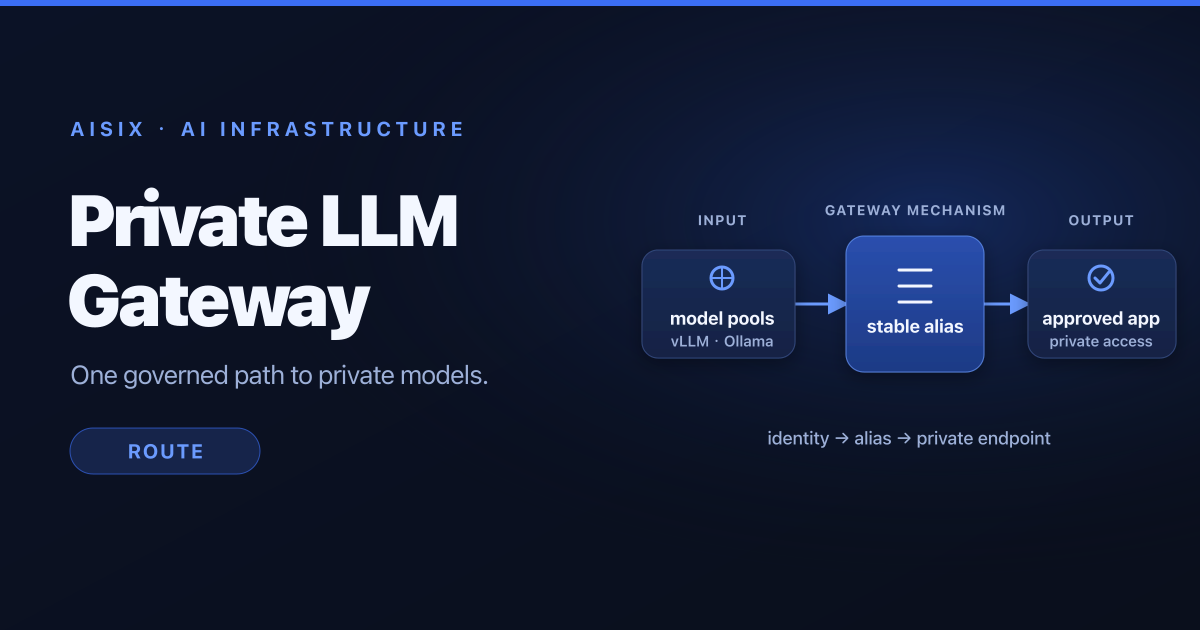
AISIX model aliases separate the name used by callers from the upstream provider model. AISIX then uses provider adapters to translate the gateway contract to supported upstream protocols.
Separate Caller Identity from Provider Credentials
Applications should authenticate to the gateway with a caller identity issued by the platform. They should not receive the upstream provider credential.
This separation produces several controls:
- one provider credential can serve several approved applications without exposing the secret;
- one application can use several providers without storing several secrets;
- model access can be restricted per caller;
- usage can be attributed to the calling application rather than only the provider account;
- upstream keys can be rotated without coordinating application deployments.
The AISIX provider-key rotation workflow keeps caller API keys and model aliases stable while operators replace the upstream credential and repoint affected models. In a multi-cloud platform, this is a core operational requirement rather than a convenience.
Use Adapters, but Preserve Provider Semantics
An OpenAI-compatible API can reduce application integration work, but compatibility has limits. Authentication, streaming details, tool behavior, error formats, and model-specific features still vary.
The AISIX provider overview includes setup paths for OpenAI, Azure OpenAI, Anthropic, Amazon Bedrock, Google Vertex AI, Gemini, and other providers. It also supports bring-your-own OpenAI-compatible endpoints such as vLLM, SGLang, or Ollama.
Treat the adapter as a controlled translation layer. Define which features each alias supports, validate request fields, and expose provider-specific behavior only when the application genuinely requires it.
The application-facing request can remain simple:
curl -sS "${AI_GATEWAY_URL}/v1/chat/completions" \
  -H "Authorization: Bearer ${AI_GATEWAY_KEY}" \
  -H "Content-Type: application/json" \
  -d '{
    "model": "support-chat-eu",
    "messages": [
      {"role": "user", "content": "Summarize this support case."}
    ]
  }'
Only the gateway configuration knows whether support-chat-eu resolves to Azure OpenAI, Vertex AI, Bedrock, a SaaS provider, or a private model. The alias name also carries an explicit regional promise that routing policy must preserve.
Choose a Multi-Cloud Topology
There is no single correct placement for an AI Gateway. Choose a topology based on latency, failure isolation, network ownership, residency, and operational capacity.
Central Gateway
A central gateway is the simplest control point. All applications call one deployment or one globally addressed service. Policy, credentials, and telemetry are concentrated.
This works well when applications and model endpoints are geographically close enough, traffic can legally cross the central location, and the organization accepts the gateway as a shared failure domain. It becomes weaker when inter-region latency is material, egress costs are high, or regulations require local processing.
Regional Gateways with Shared Policy
Regional gateways place the data plane near applications and approved provider endpoints. Each region can use a local model pool and a local alias such as support-chat-eu or support-chat-us. A management layer distributes environment-scoped resources while live inference traffic remains regional.
This topology reduces latency and isolates regional failures, but it introduces configuration discipline. Operators must know which environment projects to which gateway, which credentials are eligible in each environment, and whether policy changes should be global or regional.
The AISIX organization and environment model separates organization-level ownership from environment-scoped models, caller API keys, and policies. Use environments to make deployment boundaries visible instead of relying on naming conventions alone.
On-Premises Gateway and Private Models
Regulated data, air-gapped networks, or predictable high-volume inference may require a private gateway and private models. The gateway can expose the same application contract while routing approved traffic to an internal OpenAI-compatible endpoint.
Private does not automatically mean compliant. Teams still need data classification, IAM, network egress controls, key management, patching, model governance, and audit retention. The gateway gives those controls one enforcement point, but it does not replace them.
flowchart TB
  CP["Managed or private control plane"] -->|"environment policy"| EU["EU gateway"]
  CP -->|"environment policy"| US["US gateway"]
  CP -->|"environment policy"| OnPrem["On-premises gateway"]

  EU --> EUModels["EU-approved cloud models"]
  US --> USModels["US-approved cloud models"]
  OnPrem --> Private["Private model cluster"]

  EU -. "no cross-boundary fallback" .-> USModels
  US -. "policy-controlled fallback only" .-> EUModels
The dotted paths are not recommendations. They represent decisions that must be explicitly allowed or denied. A multi-cloud design is trustworthy only when prohibited paths are impossible, not merely undocumented.
Make Routing Respect Compliance Boundaries
Traditional failover chooses another healthy upstream. Multi-cloud AI failover must first choose another eligible upstream.
Eligibility can depend on:
- data classification and customer consent;
- provider and model approval;
- region or geography;
- contract and retention terms;
- required content controls;
- private connectivity;
- model capability and quality;
- budget and quota state.
Build model pools within those boundaries. An EU-restricted alias should contain only targets approved for that data and region. If all eligible targets fail, return a controlled error or queue the work. Do not silently cross into a prohibited region to improve availability.
Cloud platforms have their own regional behavior. Amazon Bedrock inference profiles can route invocations across one or more AWS Regions. That can improve throughput, but the allowed destination Regions must match the workload's policy. Microsoft documents how data is processed and stored for Azure Direct Models, while Google documents security and data-residency controls for Generative AI on Vertex AI. These provider controls are inputs to gateway policy, not substitutes for it.
Health checks, retries, and circuit breaking should also stay bounded. A retry against the same failing provider can increase latency and cost. A retry against another provider can change data handling and output quality. The AISIX routing and failover documentation is the starting point, but production policy must define eligible targets and maximum attempts for each alias.
Unify Security and Observability
Multi-cloud designs often centralize requests while leaving security fragmented. Avoid using the gateway merely as a URL router.
At the gateway boundary, enforce:
- caller authentication and model allowlists;
- provider credentials held outside application code;
- request, token, concurrency, and budget controls;
- prompt or response guardrails appropriate to the data class;
- TLS for callers and secure upstream connections;
- trace identifiers and structured logs;
- redaction rules that prevent prompts or secrets from leaking into logs.
Connection security has several independent layers. AISIX TLS and mTLS distinguishes listener TLS, self-hosted etcd TLS, and managed gateway-to-control-plane mTLS. Enabling one does not protect the others. Upstream provider TLS and private network controls are separate again.
Observability should answer:
- Which caller and environment sent the request?
- Which stable alias did it request?
- Which provider, region, and model served each attempt?
- Did routing, retry, or fallback occur?
- What were token usage, latency, time to first token, and cost?
- Which policy or guardrail changed the outcome?
Use a consistent telemetry schema and export traces, metrics, and logs to the organization's observability stack. OpenTelemetry provides a vendor-neutral foundation, while gateway usage reporting can add AI-specific dimensions such as requested alias and resolved model.
Implementing the Pattern with AISIX AI Gateway
AISIX AI Gateway is an open-source, Rust-native gateway for LLM and AI-agent traffic. It runs as a single static binary and supports stable aliases, gateway-side provider credentials, routing, traffic policy, and observability.
Its deployment options use the same gateway runtime in three operating models:
| Option | Management location | Typical fit |
|---|---|---|
| Open-source AISIX gateway | Declarative resources.yaml and startup configuration | Teams building their own platform workflows |
| AISIX Hybrid Cloud | Gateway in your runtime; API7-operated managed control plane | Central management without operating the control plane |
| AISIX On-Premises | Control plane and gateways in your infrastructure | Residency, isolation, compliance, or air-gapped requirements |
In AISIX Hybrid Cloud, applications call the gateway in the customer's runtime environment, and the gateway calls upstream providers directly. Live proxy traffic does not pass through the API7-operated control plane. The gateway connects outbound for management, telemetry, and managed services such as budget checks.
AISIX On-Premises keeps the managed control plane and its data inside customer-controlled infrastructure. The open-source option loads dynamic resources from a declarative resources.yaml file and does not include managed organization, usage, or budget workflows. These differences should be part of architecture selection; they are not interchangeable packaging labels.
What the Gateway Does Not Replace
A credible design states what remains outside the gateway:
- cloud account, subscription, and project governance;
- provider IAM and service-control policies;
- data classification and privacy review;
- KMS, secret lifecycle, and certificate authority operations;
- private connectivity, DNS, firewall, and egress policy;
- provider contracts, regional terms, and model approval;
- invoice reconciliation and enterprise financial accounting;
- model evaluation, quality testing, and responsible AI review.
The gateway coordinates runtime policy across these systems. It cannot infer legal or business constraints that the organization has not encoded.
Migration Plan and Validation Checklist
Move to a multi-cloud gateway in controlled stages:
- Inventory every application, provider endpoint, model ID, credential, region, quota, and data class.
- Group workloads by capability and compliance boundary, not by provider brand.
- Define stable aliases with documented quality, region, cost, and fallback expectations.
- Issue caller identities and model allowlists to a small pilot group.
- Move provider credentials to gateway-managed resources.
- Establish one primary target per alias before adding failover.
- Add eligible secondary targets and test real provider failures.
- Validate telemetry, token counts, cost, and alias-to-provider audit trails.
- Deploy regional or private gateways where latency or policy requires them.
- Remove direct provider credentials from applications after the gateway path is proven.
Before production, verify:
- Can a provider credential rotate without changing application configuration?
- Does every alias define approved regions and data classes?
- Can failover cross a region or provider only when policy allows it?
- Are provider-specific errors normalized without hiding useful details?
- Do logs show both requested aliases and resolved provider models?
- Are retries bounded and included in cost reporting?
- Does a control-plane interruption leave the expected data-plane behavior?
- Are regional gateway configuration and certificate renewal tested?
- Can private endpoints be reached without opening unintended egress?
- Does the disaster-recovery plan preserve residency and access policy?
Conclusion
Multi-cloud AI architecture should give application teams choice without giving every application a collection of provider SDKs, secrets, and compliance decisions.
The gateway contract is the stable center: callers use approved aliases and identities; platform teams control provider adapters, credentials, regions, routing, limits, and telemetry. Central, regional, and on-premises gateways can all implement that contract, but each topology has different latency, failure, and governance tradeoffs.
Use AISIX AI Gateway when applications need one model-facing API while the platform retains explicit control over AWS, Azure, Google Cloud, SaaS providers, and private endpoints. Design eligibility before failover, preserve both alias and resolved-model data, and test prohibited paths as rigorously as successful requests.