LLM Routing Is Not a Pricing Spreadsheet: How to Govern Cost, Cache, and Latency

August 4, 2026
Key Takeaways
- Recent developer discussions showed that model routing decisions often fail when teams optimize against published token prices instead of effective production cost.
- Caching behavior, routing overhead, endpoint conditions, and workload shape can matter more than sticker-price tables when you compare providers or models.
- Per-vendor dashboards are not enough for multi-model operations because platform teams need one place to compare effective cost, latency, retries, and cache behavior across routes.
- A modern AI Gateway should treat routing as a systems optimization problem spanning cost, latency, reliability, policy, and observability.
- The best routing design uses model aliases, eligibility policy, caching, and telemetry together instead of trying to "guess the best model" from price sheets.
On July 15, IBM Research published Model Routing Is Simple. Until It Isn't., a practical reminder that routing problems are usually more about systems behavior than about model metadata. Around the same time, Artificial Analysis highlighted why developers were paying attention to DeepSeek V4 Flash: aggressive pricing, strong speed, and a large context window.
These signals all point to the same conclusion.
LLM routing is not a pricing spreadsheet problem.
It is a runtime governance problem.
Why Sticker Price Misleads Almost Immediately
Most routing conversations begin with a simple assumption: cheaper-token model for simple work, expensive-token model for hard work, and maybe a fallback when the primary route fails.
That is directionally useful, but it breaks down fast in production.
IBM's AppWorld routing writeup is the cleanest recent example. The team compared GPT-4.1 and Claude Sonnet 4.6 across 417 agent tasks and found that Sonnet cost $79 total while GPT-4.1 cost $155 total, even though GPT-4.1 had lower published input and output pricing. Their explanation was not a marketing slogan or a model benchmark anomaly. It was caching. Workloads with repeated context changed the economics so much that nominal pricing became the wrong number to optimize.
That result should not surprise platform teams, because production cost is always compound: token price, cache hit rate, output verbosity, retries, routing overhead, fallback frequency, provider latency, and prompt shape.
Once you care about end-to-end task cost, the model card stops being enough.
This is also why AI cost governance is not solved by picking "the cheapest model." A cheaper model that fails more often, requires more tool loops, or generates more output can become the expensive option. A more expensive model with better cache economics or shorter trajectories can be cheaper in practice.
Routing Is a Systems Problem, Not a Classification Problem
The Hugging Face article makes another important point: routing is often treated as if it were a classification problem. Estimate task difficulty, map it to a model tier, and move on.
Two implementation views make that decision more concrete: multi-LLM routing with local Qwen and cloud models shows a provider-routing pattern, while workload-specific AI Gateway strategies separates offline, online, and bursty agent workloads.
That is too narrow for enterprise traffic.
Production routing must balance at least five variables at the same time:
- Cost
- Latency
- Quality
- Reliability
- Policy
And policy is where many routing writeups stay too abstract. In real environments, not every model is allowed for every workload. Some data must stay in region. Some prompts can only go to approved vendors. Some business units get premium models, while others use cost-optimized tiers. Some routes must fail closed instead of failing over to any available provider.
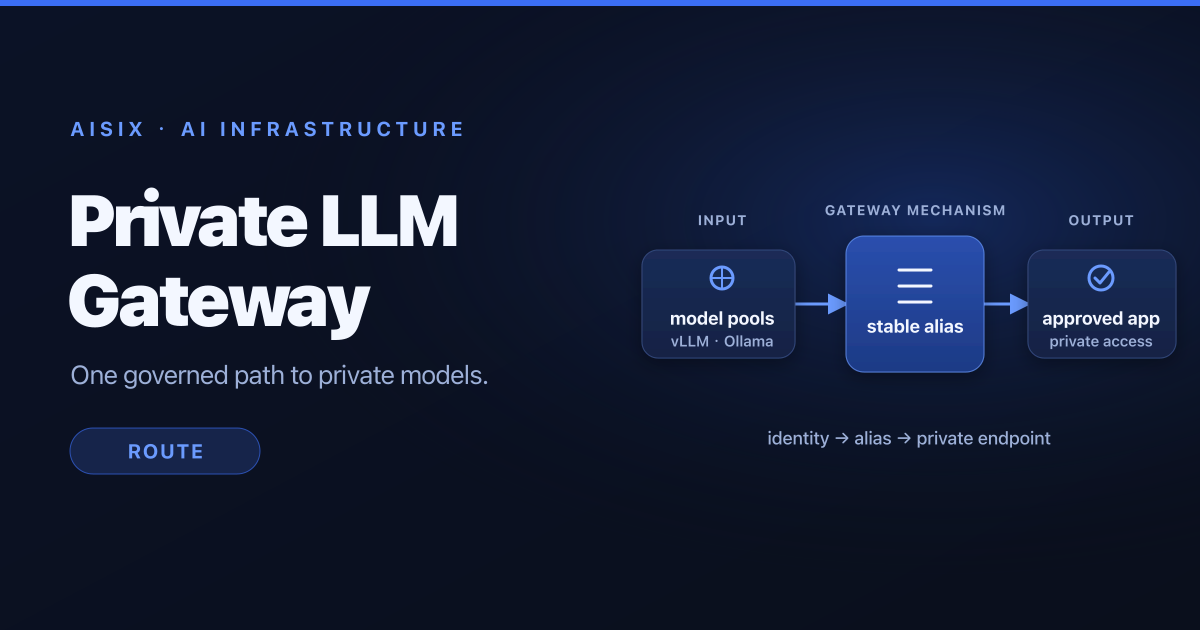
The AISIX AI Gateway perspective is useful here because it keeps routing attached to governance. The gateway is not just choosing a model. It is enforcing a runtime contract: approved aliases, provider-key handling, route eligibility, auditability, and safe fallback behavior.
That is much closer to what platform teams actually need.
The Four Cost Variables Teams Keep Missing
1. Cache Economics
Caching is no longer a nice-to-have detail. It changes model economics.
The existing API7 post on how AI gateways cut costs with smart caching explains why repeated prompts, repeated context blocks, and shared system instructions create large savings opportunities. What the July 2026 routing discussion adds is a sharper lesson: caching does not only lower bills, it changes which model is optimal.
If one provider has better cache-read pricing or better cache behavior for your workload, the "cheaper" model on paper may lose in practice.
2. Output Shape and Verbosity
Developers often focus on input price because it is easy to compare. But output pricing and response style matter too.
The Artificial Analysis profile for DeepSeek V4 Flash shows why the conversation around it accelerated: the model combines strong speed, aggressive pricing, and a large context window. But even when a model is competitively priced, verbosity still affects total task cost. A fast, low-cost model that emits far more tokens than a competing route can erase part of its pricing advantage.
3. Routing Overhead
A router that adds too much latency or complexity can become the bottleneck it was supposed to remove. IBM explicitly called this out. Routing choices themselves add overhead, and infrastructure conditions often dominate what the user experiences.
This is why routing logic should be lightweight and observable. A route that looks optimal in a benchmark but adds lookup delays, extra inference passes, or cascading retries can hurt the user experience more than a stable default alias.
4. Dashboard Fragmentation
Even when providers expose usage dashboards, those dashboards answer the provider's questions, not the platform team's questions.
Cursor's cost-visibility threads are a useful proxy for a wider enterprise problem. Users were frustrated because missing cost details made budgeting and usage planning harder. In a single-tool workflow that is annoying. In a multi-provider enterprise stack it becomes operationally dangerous.
If one team uses OpenAI, another uses Anthropic, and a third uses a local or open-weight route, nobody can make good tradeoffs from fragmented dashboards alone. Platform teams want effective cost by alias. Reliability teams want latency by provider. Security teams want to know which routes are approved. Application teams want one endpoint and one contract.
That is gateway territory.
Why Per-Vendor Spend Views Are Not Enough
An AI platform needs unified answers to questions like:
- Which model alias cost the most this week?
- Which provider had the worst cache-hit rate?
- Which route changed its effective cost unexpectedly?
- Which routes are fast but unreliable?
- Which "cheap" model became expensive because of retries or verbose output?
- Which prompts should be routed differently because their context structure changes cache behavior?
Per-vendor dashboards cannot answer this consistently because they only see the part of the flow they serve.
Gateway-side telemetry can.
That is the bigger argument behind What Is an AI Gateway and the ongoing shift described in The Future of AI Gateways: From Proxy to Intelligent Orchestrator. AI traffic needs a control layer that can see across providers, aliases, retries, caches, and policies in one place.
What Good Cost-Aware Routing Looks Like in Practice
The core design pattern is simple:
Stable Model Aliases
Applications should call stable aliases such as prod-chat, cost-optimized-code, or premium-analysis, not raw provider model IDs. This lets the platform team change the underlying route without changing application code.
Effective-Cost Telemetry
The platform should measure real task economics:
- input tokens,
- output tokens,
- cache hit and miss behavior,
- retries,
- fallback usage,
- end-to-end latency,
- and estimated cost by alias and by provider.
Keep Financial Controls Separate
Routing telemetry can inform financial policy, but route selection should not become the owner of allocation, showback, chargeback, or layered budget rules. The companion guide to AI Gateway cost control covers those responsibilities and their enforcement lifecycle.
Policy-Aware Routing
Routing should consider more than price and difficulty:
- approved providers,
- region or residency,
- data sensitivity,
- fallback rules,
- team-level entitlements,
- and whether open-weight or self-hosted routes are required.
Caching as a Routing Input
Caching policy should not be separate from routing policy. If one route benefits much more from warm context or repeated prompts, that should influence alias design and routing logic.
A Reference Architecture for Cost-Aware Routing
flowchart LR
    App[Application or Agent] --> Gateway[AI Gateway]
    Gateway --> Alias[Model Alias Layer]
    Gateway --> Cache[Prompt and Semantic Cache]
    Gateway --> Policy[Eligibility and Fallback Policy]
    Gateway --> Obs[Cost and Latency Telemetry]
    Alias --> ProviderA[Provider A]
    Alias --> ProviderB[Provider B]
    Alias --> Local[Local or Open-Weight Route]
    ProviderA --> Obs
    ProviderB --> Obs
    Local --> Obs
In this model, routing is no longer a hidden heuristic living inside one application. It is a platform capability. The gateway observes the route, applies policy, captures telemetry, and can change the alias target when economics or reliability change.
That is a much better fit for enterprise AI than hardcoding provider decisions into every service.
How to Start Without Overengineering
Many teams do not need a complex router on day one. They do need better control than direct-provider calls.
Start with:
- one gateway endpoint,
- a small set of stable aliases,
- unified telemetry,
- explicit cache policy,
- and explicit provider and region eligibility.
Then add sophistication only where the data justifies it:
- a low-cost alias for high-volume, cache-friendly workloads,
- a premium alias for high-accuracy work,
- a constrained route for sensitive data,
- and a fallback route for availability.
This approach keeps routing grounded in observable behavior instead of routing hype.
Final Thought
This week's routing and cost discussions were useful because they exposed a recurring mistake in AI infrastructure design.
Teams keep trying to optimize AI spend from price tables, vendor dashboards, and static "simple vs complex" assumptions. But real cost emerges from runtime behavior: cache reuse, retries, verbosity, endpoint conditions, routing overhead, and policy constraints.
That is why LLM routing should be treated as a gateway problem, not a spreadsheet exercise.
The right platform does not just pick a model. It makes cost, cache, latency, and policy visible enough that model choice becomes governable.