AI Gateway Cost Control: Budgets, Quotas, and Chargeback

August 4, 2026
Key Takeaways
- AI cost control needs more than provider invoices or token dashboards. It needs a runtime loop that measures, prices, allocates, limits, and explains spend.
- Rate limits protect capacity, while budgets protect money. A workload can stay within request limits and still overspend by using larger prompts or more expensive models.
- Cost attribution starts with caller identity. Every usage record should connect an application, environment, team, or tenant to the requested alias and the model that actually served the request.
- Layered budgets let platform teams combine organization, environment, caller API key, provider key, team, and member controls instead of relying on one global cap. An application can use a dedicated caller API key when application-level attribution is required.
- A
budget_exceededresponse is a policy decision, not a transient provider error. Clients should not create retry storms against a depleted budget. - AISIX AI Gateway can enforce managed budgets before an upstream model call and report usage by environment, model, and caller API key.
Generative AI changes the shape of infrastructure cost. An ordinary API often has a reasonably stable cost per request. An LLM request can vary by prompt length, generated output, model tier, provider, region, and whether the request triggers retries or fallback. Two calls to the same application endpoint can have radically different costs.
Provider billing consoles are useful, but they arrive too late to be the only control. By the time a finance or platform team sees an unexpected invoice, the traffic has already reached the model. Application logs may explain the feature that generated the call, but they often do not preserve the provider's token counts, resolved model, or final cost. Meanwhile, provider accounts rarely map cleanly to internal teams, tenants, and environments.
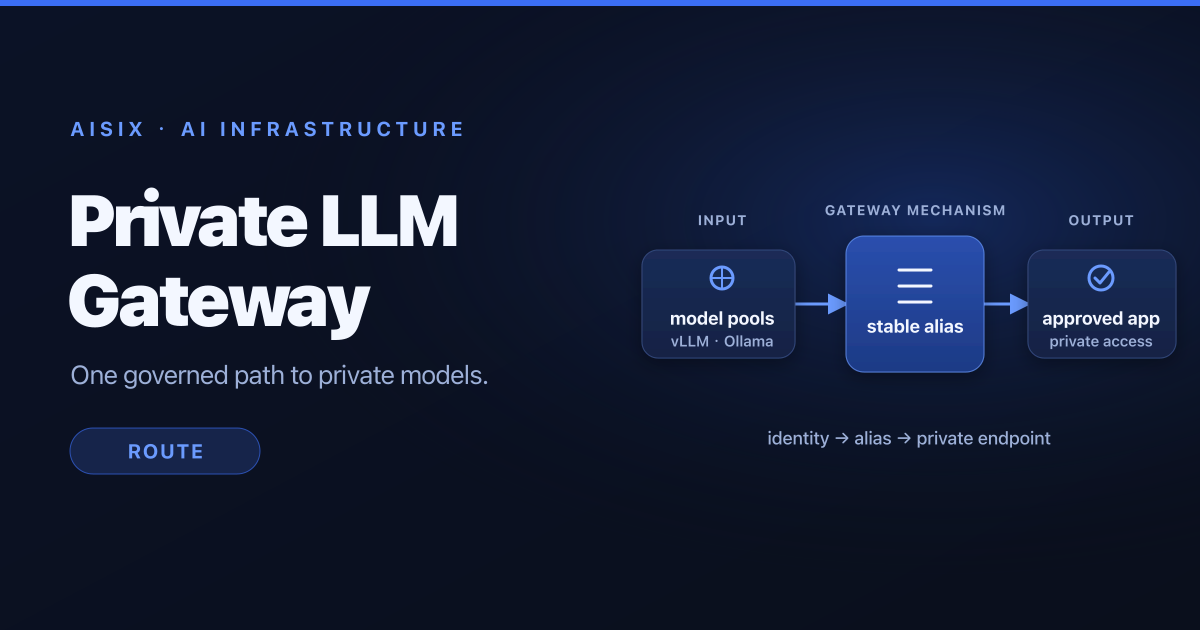
An AI Gateway can close this gap because it sits on the request path. It knows who called, which model alias was requested, which upstream served the request, and what the provider returned. That position makes the gateway a practical enforcement point for AI cost management, not merely another dashboard.
The AI Gateway Guide places cost control in the broader operating model for routing, rate limits, security, and observability. This article stays focused on runtime cost attribution and AISIX budget behavior.
Why AI Cost Control Needs a Gateway
The FinOps Foundation's guidance for AI highlights the unpredictability, granular usage, and cross-platform nature of AI spend. The operating challenge is not just reducing a bill. Teams need allocation, forecasting, optimization, and accountability that connect technical consumption to business value.
Those jobs require two loops:
- A financial loop reconciles provider invoices, negotiated rates, commitments, and accounting data.
- A runtime loop identifies usage as it happens and applies policy before the next expensive call leaves the organization.
The gateway belongs in the runtime loop. It should not replace the invoice or financial ledger. Instead, it supplies timely, identity-aware data and an enforcement point that invoices cannot provide.
flowchart LR
  App["Application or agent"] -->|"caller identity + model alias"| Gateway["AI Gateway"]
  Gateway --> Identity["Resolve owner"]
  Identity --> Policy["Check limits and budgets"]
  Policy -->|"allowed"| Provider["Model provider"]
  Policy -->|"blocked"| Deny["Budget response"]
  Provider --> Usage["Tokens, latency, status"]
  Usage --> Pricing["Apply model price"]
  Pricing --> Allocation["Allocate spend"]
  Allocation --> Reports["Showback, chargeback, forecast"]
  Reports --> Policy
Rate Limits Are Not Budgets
Rate limits answer questions such as:
- How many requests may this caller send per minute?
- How many input or output tokens may it consume during a window?
- How many concurrent generations may run?
Budgets answer a different question: how much money may this owner spend during a period?
The distinction matters because request volume is a poor cost proxy. One thousand requests to a small model with short prompts may cost less than ten requests to a premium model with long context and large output. Token limits are closer to cost, but different models and providers price the same token counts differently. Retries and fallback can also change the final cost of one logical application request.
Use rate limits to control flow, concurrency, and abuse. Use budgets to express financial policy. In production, most organizations need both. The existing guide to AI Gateway rate limiting explains the traffic-control side; this article focuses on the financial control loop.
Build the Cost Data Model First
A budget is only as trustworthy as the usage data below it. Before enforcing a dollar limit, establish a record that can explain every charged attempt.
At minimum, capture:
- caller API key or another stable workload identity;
- organization and environment;
- team, member, tenant, application, or cost center where available;
- caller-requested model alias;
- resolved provider and upstream model;
- input, output, cached, and other billable token classes exposed by the provider;
- request status, latency, retries, and time to first token for streaming calls;
- timestamp and a request or trace identifier;
- calculated cost and the price version used for that calculation.
The requested alias and resolved model are both important. Suppose applications call production-chat, while the gateway normally routes to one model and fails over to another. A report that stores only production-chat cannot explain a cost spike caused by the fallback target. A report that stores only the provider model loses the stable product contract used by application owners.
AISIX usage reporting keeps these concepts separate: telemetry can include the requested model alias and the resolved model that served an attempt. This also helps interpret multi-target routing and ensemble traffic.
Convert Usage into Spend
Token counts are not spend until they are joined with a price. The pricing key normally includes at least provider, model, token class, currency, and effective period. If a provider/model pair has no matching price, the system should report usage without inventing a cost.
That caveat matters during model launches and provider migrations. A new upstream may start serving traffic before a price catalog is updated. A dashboard can then show tokens but no dollars. Treat missing prices as a data-quality alert, not as free usage.
AISIX managed usage reporting relies on a matching provider and model-name price to calculate spend. Platform teams should review the model pricing workflow whenever they add or rename an upstream model.
Provider-native allocation remains useful. For example, Amazon Bedrock inference profiles can track usage and use tags for cost allocation. Gateway attribution complements that data by adding the application-facing identity and alias that may span more than one provider account.
Allocate Spend to the Right Owner
Cost control becomes actionable only when spend has an owner. A single provider key shared by an entire organization makes onboarding easy, but it produces a weak allocation boundary. The provider invoice shows the account total, while engineering needs to know which environment, product, team, tenant, or member created it.
The FinOps allocation capability recommends using account structures, tags, labels, and derived metadata to create transparent ownership. At an AI Gateway, caller identity is the most reliable place to attach that metadata.
A practical hierarchy can include:
| Scope | Question it answers | Typical action |
|---|---|---|
| Organization | Are we within the company-wide AI envelope? | Forecast and executive reporting |
| Environment | Is production, staging, or experimentation driving spend? | Separate caps and alert thresholds |
| Caller API key | Which application or tenant sent the traffic? | Disable, rotate, or cap one workload |
| Provider key | Which upstream account or contract is consuming money? | Protect a provider commitment or account |
| Team | Which organizational owner is responsible? | Showback or chargeback |
| Member | Is one user or automation consuming unusually high spend? | Individual allowance or investigation |
Start with showback: make owners see and acknowledge their usage without transferring money between cost centers. Showback exposes identity gaps and disputed attribution while the consequences are still low. Move to chargeback only when the data, ownership model, and exception process are stable.
Do not infer team ownership from a person's directory membership alone. Bind the actual caller credential to the intended team or tenant. Otherwise, an application can be operated by one team while its traffic is accidentally charged to another.
Enforce Layered Budgets and Quotas
One global monthly budget is too blunt for a real platform. It can stop every application because one experimental workload overspent. Layered budgets contain the blast radius and reflect how organizations assign responsibility.
A common policy stack looks like this:
flowchart TD
  Org["Organization budget"] --> Env["Environment budget"]
  Env --> Team["Team budget"]
  Env --> App["Caller API key budget"]
  Team --> Member["Member allowance"]
  Env --> Provider["Provider key budget"]
  Member --> Decision["Combined allow or deny"]
  App --> Decision
  Provider --> Decision
For each scope, define:
- a period, such as day, week, or month;
- a dollar limit or usage quota;
- a warning threshold;
- an owner and escalation path;
- whether exceeding the threshold only warns or blocks;
- what client behavior is expected after a block.
AISIX managed budgets can target an organization, environment, caller API key, provider key, team, member, or each member within a team. A request may match several budgets at once. If any matching blocking budget has reached its limit, the gateway can reject the request before contacting the upstream provider.
Warn-only budgets are appropriate while teams calibrate thresholds, for non-critical environments, or when continuity is more important than a hard cap. Blocking budgets are useful for experiments, tenant plans, provider-account protection, and workloads where the cost ceiling is explicit.
Handle Budget Rejections Deliberately
A blocking AISIX budget can return HTTP 429 with an error code such as budget_exceeded. The status code is also commonly used for short-term rate limiting, but clients should not treat the two situations identically.
async function callModel(request) {
  const response = await fetch(process.env.AI_GATEWAY_URL, {
    method: "POST",
    headers: {
      "content-type": "application/json",
      authorization: `Bearer ${process.env.AI_GATEWAY_KEY}`,
    },
    body: JSON.stringify(request),
  });

  if (response.status !== 429) {
    if (!response.ok) throw new Error(`Gateway error: ${response.status}`);
    return response.json();
  }

  const error = await response.json();
  if (error?.error?.code === "budget_exceeded") {
    // Retrying cannot replenish a budget. Stop and surface a policy outcome.
    throw new Error(`AI budget exhausted: ${error.error.message}`);
  }

  // A transient rate limit may be retried by a bounded backoff policy.
  throw new Error("AI request rate limited");
}
Do not automatically fail over to a more expensive model after a budget rejection unless policy explicitly allows it. That behavior defeats the financial control and may multiply cost. A product can instead degrade to a cheaper approved alias, queue non-urgent work, disable optional enrichment, or ask the owner to request more budget.
Operate an AI FinOps Loop
Budgets are guardrails, not the full practice. A useful operating cadence connects platform, product, finance, and security teams.
Daily or near-real-time work should include anomaly detection, missing-price alerts, sudden model-mix changes, repeated retries, and workloads approaching blocking thresholds. Weekly reviews can identify optimization candidates and unused provider capacity. Monthly reviews should reconcile gateway estimates with provider invoices, update forecasts, and agree on chargeback or showback adjustments.
Optimization should preserve business value. Reducing tokens can lower cost while also reducing answer quality. Switching to a cheaper model can increase retries, latency, or human review. Aggressive blocking can break customer-facing features. Track unit economics such as cost per successful task, resolved support case, generated artifact, or accepted recommendation rather than celebrating a lower token total in isolation.
The gateway can support several safe optimization patterns:
- route low-risk tasks to an approved lower-cost alias;
- cap output tokens by application policy;
- detect retry loops and duplicate calls;
- keep provider credentials centralized so migrations do not require application releases;
- use routing and failover with explicit cost and quality constraints;
- compare requested aliases with resolved models to find expensive fallback paths.
Implementing Cost Control with AISIX AI Gateway
AISIX AI Gateway gives applications stable model aliases and caller API keys while the platform controls provider credentials, routing, policy, and telemetry. In managed deployments, these resources form the identity chain needed for cost allocation.
The recommended rollout is incremental:
- Route a small set of applications through named caller API keys.
- Configure exact model pricing and validate token-to-cost calculations.
- Bind keys to environments, teams, members, or tenants consistently.
- Compare gateway estimates with provider billing for a full period.
- Introduce warn-only budgets at organization, environment, and caller API-key levels. Use a dedicated caller key when it represents one application.
- Add blocking budgets first to experiments and non-critical workloads.
- Document client handling for
budget_exceededbefore enforcing production caps. - Review provider-key budgets and credential rotation as part of supplier governance.
There is an important availability boundary: AISIX budget enforcement is supported through managed control-plane checks. The open-source self-hosted gateway does not provide the same budget enforcement engine. Managed gateways use short-lived decision caching, can reuse stale decisions within a configured ceiling during a control-plane interruption, and deny when no decision is available. Teams should test this behavior against their availability and cost-risk requirements.
Usage reporting has its own failure characteristics. During a temporary control-plane outage, live traffic can continue with projected configuration, but failed telemetry batches may not be replayed. Cost reports should therefore be reconciled with provider billing rather than treated as an accounting ledger.
Rollout Checklist
Before making budgets blocking, verify that you can answer each question:
- Does every production workload use a stable caller identity?
- Can every identity be mapped to an application, environment, team, or tenant owner?
- Does every active provider/model pair have a current price?
- Can reports show both requested aliases and resolved upstream models?
- Are retries and fallback attempts counted and attributable?
- Have gateway estimates been reconciled with provider invoices?
- Do owners receive warning notifications before a block?
- Does client code distinguish
budget_exceededfrom transient rate limiting? - Is there an approval path for emergency budget increases?
- Have control-plane interruption and stale-decision behavior been tested?
- Are showback disputes resolved before chargeback begins?
- Are quality, latency, reliability, and business outcomes reviewed alongside cost?
Conclusion
AI cost control is not a dashboard feature added after deployment. It is a runtime governance system built on identity, usage, pricing, allocation, budgets, and clear client behavior.
An AI Gateway is well placed to run that system because it observes the request before money is spent and the provider response after usage is known. The strongest design combines request, token, and concurrency controls with layered dollar budgets, then connects those controls to showback, chargeback, forecasting, and unit economics.
Evaluate AISIX AI Gateway when your AI platform needs one enforcement boundary for applications, environments, teams, provider credentials, and models. Start with accurate attribution and warn-only policies; make budgets blocking only after owners trust the data and applications know how to respond.