Kong AI Gateway vs AISIX: Which Gateway Fits When Teams Share AI Models?

Yilia Lin
November 6, 2026
Once a support assistant and an operations assistant share models, the platform team has more to manage. The two apps need different model permissions, batch jobs need their own rate limits, and the primary model needs a backup target. If each app handles this logic itself, changing a model or an access policy can mean updating and testing multiple configurations.
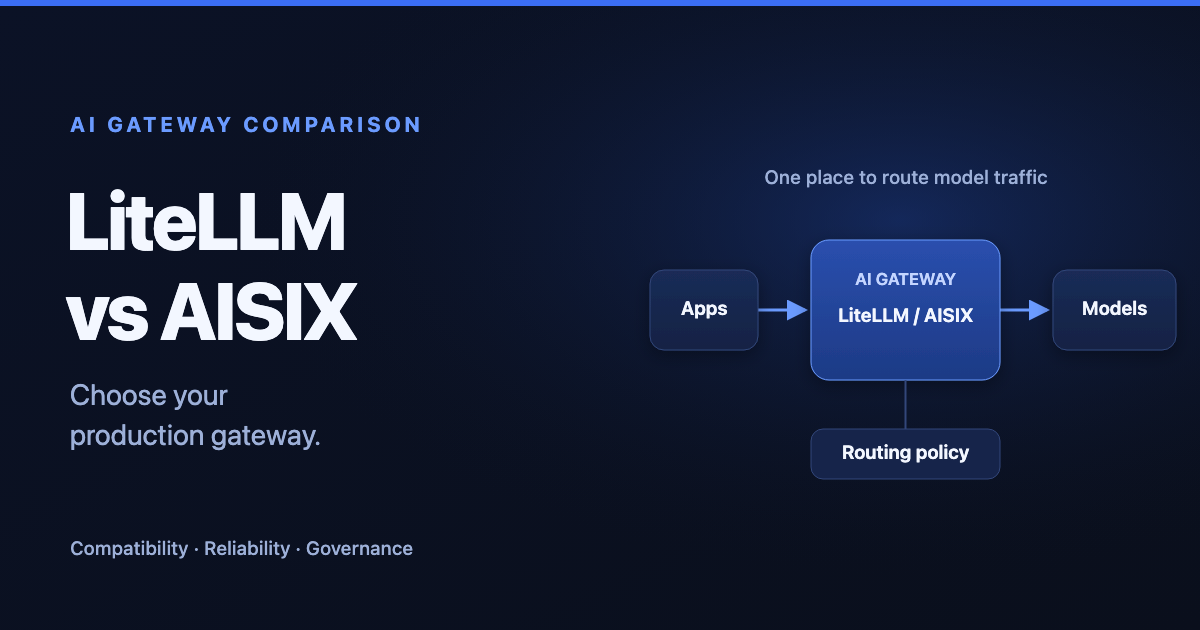
An AI gateway can handle these requirements centrally between the apps and their models. AISIX OSS, the open-source LLM gateway in AISIX AI Gateway, lets both apps use the same model alias while keeping separate credentials, model permissions, and usage limits. Primary and backup targets and their failover conditions are configured at the gateway. You can evaluate these capabilities with AISIX OSS first: run one gateway container and configure models and callers in a local resource file, without deploying a control plane first. The platform team can connect an existing app and check whether normal requests, access restrictions, rate limits, and failover behave as expected. AISIX OSS quickstart · Rate limits · Routing and failover
Kong AI Gateway also provides model integration and traffic management. For a platform team evaluating the two, the next questions are how to configure these requirements, which capabilities can be tried directly, which require a commercial license, and which components the team will need to maintain in production. We use the two assistants sharing models to compare application integration, failover, spending controls, access and content policies, and day-to-day operations.
The comparison uses Kong AI Gateway 2.3.0 and AISIX 1.8.0. The nine AISIX test cases ran against mock upstreams through one gateway instance. Kong's runtime behavior and both vendors' commercial capabilities are described from official documentation for the relevant deployment. Kong AI Gateway changelog · AISIX 1.8.0 release
How much does an existing app need to change?
The support assistant already uses the OpenAI SDK for Chat Completions. It can keep POST /v1/chat/completions and its message structure, point the SDK at the gateway, use a gateway credential, and set model to shared-model. The operations assistant uses the same endpoint and model name with its own credential. Both apps can keep the alias when the platform team changes the upstream target. AISIX Proxy API · Kong model routing rules
In AISIX OSS, the alias and its targets can live in resources.yaml. Our shared-model alias pointed to a primary and a backup. In Konnect, Kong can expose the same application interface by setting an AI Model's route and matching the alias in the request body with config.route.model. For self-hosting, Kong documents how decK translates that definition into gateway routes and plugins. For an existing OpenAI Chat Completions client, both evaluations can start by changing the URL, credential, and model name on one existing request. AISIX Proxy API · Kong AI Model · Kong on-prem configuration
If the assistant streams replies to the UI or calls a tool to look up orders, exercise that full path. An alias stays stable, while tool arguments, stream completion events, and native API capabilities depend on the entry point and target. AISIX offers Anthropic Messages and OpenAI Responses endpoints, for example, and Anthropic's count_tokens requires an Anthropic upstream. Kong also distinguishes OpenAI-compatible formats from provider-native formats. Run the same application request against both targets and check that the app can parse the response and finish the tool call. AISIX provider compatibility · Kong request and response formats
What does the user see when the primary model fails?
Suppose the support assistant is drafting a reply when the primary target returns 503. In our test, the primary and backup were two HTTP paths on the same mock service, using the same mock model. We gave the primary higher priority, set same-target retries to 0, and allowed one fallback. App A sent one non-streaming request. AISIX received 503 from the primary and 200 from the backup, then returned 200 with the text backup to A. In a separate normal case, App B called the same alias and received 200 from the primary. AISIX routing and failover
flowchart TB
    subgraph Fault["App A · Failure case"]
        A["JWT A"] --> GA["AISIX OSS checks caller"]
        GA --> MA["shared-model"]
        MA --> PA["Try primary"]
        PA -->|503| FA["Gateway switches to backup"]
        FA --> QA["Try backup<br/>Keep the same request ID"]
        QA -->|200| RA["App A receives 200 · backup"]
    end

    subgraph Normal["App B · Normal case"]
        B["JWT B"] --> GB["AISIX OSS checks caller"]
        GB --> MB["shared-model"]
        MB --> PB["Try primary"]
        PB -->|200| RB["App B receives 200"]
    end
Figure 1. Two independent cases on the same AISIX OSS 1.8.0 gateway. Both upstream attempts and the response to App A carried the same request ID. App B's normal request had its own ID.
Kong can also configure tiers with priority. The default failover_criteria are error and timeout, covering errors or timeouts when connecting, sending the request, or reading response headers. To cover the same 503 case, add http_503, allow a retry, and configure non_idempotent as documented for this kind of POST. In a self-hosted deployment, AI Proxy Advanced handles this routing and requires an AI license. Kong load balancing · Kong 503 fallback example · AI Proxy Advanced license
The test answers what happens when the primary returns an explicit 503 before the reply starts. For streaming Chat Completions, AISIX can switch targets only before it starts sending the response. If a timeout interrupts a reply already on screen, the stream ends. Test how the app detects and displays that incomplete reply. AISIX streaming failover
Can you control spending across teams?
Once the operations assistant starts processing tickets in batches, there are four decisions to make. Usage limits determine how many requests or tokens an app can use. Cost tracking prices the usage. Budget alerts tell someone when spending reaches a threshold. Spend enforcement determines whether new requests can still go through.
AISIX OSS lets you set request, token, or concurrency limits per caller and export metrics, logs, and usage events to your existing observability stack. If replicas need shared counters, you can configure Redis. The platform team can then set separate allowances for the support and operations apps. AISIX Enterprise and Cloud add centralized usage reporting, model pricing management, and monetary budgets. AISIX rate limits · AISIX management capabilities
With AISIX Enterprise or Cloud, you can set budgets for teams, members, callers, or cost tags, among other scopes. Configure alert thresholds and choose whether to block once a budget runs out. The control plane aggregates spending and distributes budget state. Once the gateway receives the exhausted state for a blocking budget, it rejects matching requests before calling the provider. The request that crosses the threshold can still complete, as can requests admitted while the new state is reaching the gateway. AISIX budget enforcement
Kong configures alerts and enforcement separately. Konnect AI Cost Management tracks spend and sends threshold notifications. Requests continue when that budget is exceeded. For enforcement, configure AI Rate Limiting Advanced with a cost strategy and a threshold per time window, scoped to a Consumer or Consumer Group, for example. Self-hosted gateways use the AI-licensed plugin for cost-based rate limiting. Kong budget alerts · Kong cost-based rate limiting · Self-hosted rate-limiting plugin
Kong's 2.3.0 on-prem runtime also introduced a dynamic pricing catalog. With dynamic pricing enabled, explicit target pricing takes precedence, and targets without price fields can use the catalog. The release notes describe how cost-based rate limiting uses catalog prices to reserve quota for in-flight requests. That reservation affects concurrent admission. The gateway calculates the final cost from usage and the applicable price. A concurrent batch test can show how reservations, final usage, and later rejections interact. Kong AI Gateway 2.3.0 changelog · Kong model pricing
Where do access and content policies take effect?
Both apps can use shared-model, but the internal model ops-only is reserved for operations. In the AISIX OSS test, a script issued short-lived HS256 JWTs. The gateway verified the signature, issuer, audience, and expiry, then mapped the token subject to a caller. An invalid signature or an expired JWT returned 401. The support identity received 403 when it requested ops-only with a valid JWT, while operations could call it. Once support used up its configured allowance of two requests per day, its next request received 429 and operations could still call the shared alias. All three rejection types occurred before an upstream call. AISIX JWT authentication · AISIX caller and model limits
Kong can apply Key Auth or OpenID Connect to an AI Model and grant access to selected AI Consumers or Consumer Groups. Self-hosted deployments use the corresponding gateway plugins, and the OpenID Connect plugin requires an Enterprise license. With a real identity provider, test a group membership change using both a still-valid token and a newly issued one to see when it takes effect on the model route. Kong authentication strategies · Kong model access control · Kong OpenID Connect plugin
With output blocking or masking enabled, output checks affect when the support agent first sees a reply. On Chat Completions, AISIX guardrails such as custom scripts can check and release windows of content. AISIX semantic screening holds the complete reply for inspection and can deliver it in streaming format after it passes. On Messages and Responses in AISIX 1.8.0, AISIX holds the full response when an output guardrail can block or mask content. AISIX guardrail behavior · AISIX semantic screening
Kong's managed AI Semantic Response Guard policy checks the full reply. It sets stream=false upstream and uses vector similarity rules to decide whether to allow the output. Self-hosted teams can evaluate the AI-licensed gateway plugin of the same name under its documented topology requirements. For chunked inspection, Kong's AI AWS Guardrails policy can run in OUTPUT or BOTH mode and send buffered chunks to Bedrock for evaluation. Try the same response that should trigger a block in each configuration and record when the first text appears and how much the app has received at the point of enforcement. Kong managed semantic response policy · Kong semantic response plugin · Kong AWS Guardrails
What will your team operate and troubleshoot in production?
The gateway handles application requests. The control plane distributes configuration and receives telemetry. A deployment decision determines who scales and upgrades the gateway, who responds when it fails, and who operates the management services.
flowchart TB
    subgraph AISIX["AISIX"]
        direction LR
        AA["App"] --> AG["Gateway · Customer-run"]
        AG --> AM["Upstream model"]
        AF["OSS config file · Customer"] -. Config .-> AG
        AE["Enterprise control plane · Customer"] <-.-> AG
        AC["Cloud control plane · API7"] <-.-> AG
    end

    subgraph KONG["Kong AI Gateway"]
        direction LR
        KA["App"] --> KO["Self-hosted gateway · Customer"]
        KA --> KH["Hybrid gateway · Customer"]
        KA --> KD["Dedicated Cloud gateway · Kong"]
        KO --> KM["Upstream model"]
        KH --> KM
        KD --> KM
        KL["Local administration · Customer"] -. Config .-> KO
        KC["Konnect control plane · Kong"] <-.-> KH
        KF["Dedicated Cloud control plane · Kong"] <-.-> KD
    end
Figure 2. Deployment and operating responsibilities. Solid arrows show the request path through the selected gateway. Dashed arrows show configuration, and two-way dashed arrows include telemetry. The AISIX gateway node represents three separate deployment choices.
With AISIX OSS in file mode, the customer runs the gateway and maintains the resource file. It can run on its own. With AISIX Enterprise, the customer also operates the cp-api and dp-manager services and PostgreSQL. Production use of the control plane and dashboard requires a commercial license. With AISIX Cloud, API7 operates the control plane while the customer continues to operate the gateway, which connects to management over mutual TLS. That suits teams that want hosted management and still need to control where inference traffic flows. AISIX deployment options · Enterprise deployment · Enterprise licensing · Connecting a gateway
Kong's official self-hosted Compose path for 2.3.0 asks the customer to run the gateway and PostgreSQL, run database migrations, and provide an Enterprise license. Apply the AI configuration with deck ai sync. In a Konnect hybrid deployment, Kong runs the control plane and the customer runs the gateway. With Kong Dedicated Cloud, Kong runs both and handles gateway scaling, upgrades, and high availability. Kong on-prem installation · Kong hybrid architecture · Kong Dedicated Cloud
Open-source availability depends on the component. AISIX OSS is an Apache-2.0-licensed AI gateway; the request controls shown here can be evaluated without its commercial control plane. Kong Gateway also has an open-source distribution, while the AI Proxy Advanced and AI Rate Limiting Advanced plugins referenced here require AI licenses. Gateway licensing and infrastructure costs are separate from model-provider usage charges. For the broader commercial packaging, see our Kong Konnect pricing guide. AISIX OSS license · Kong Gateway license
Back to the support request. The app saw 200, but the on-call engineer needs to know that the primary returned 503. Using x-aisix-request-id from the response, we can find these three entries in the gateway logs. The extract shortens the request ID and keeps the fields relevant to troubleshooting.
request_id=79eec4ce… target_model=primary error="upstream returned HTTP 503: injected fault"
request_id=79eec4ce… attempt_index=1 attempt_kind=fallback status=200
request_id=79eec4ce… status_code=200 served_by_model=backup routing_attempt_count=2
The entries show the primary failure, the successful fallback, and the final outcome for the app. Monitoring client outcomes separately from upstream failures and successful fallbacks lets you spot a deteriorating primary even when application success stays flat. In a Kong evaluation, use X-Kong-Request-Id to find the request in logs and verify which attempt fields, such as tries, are available on the AI route you deploy. AISIX metrics and usage events · Kong request IDs · Kong log fields
Start with one existing application
Pick an app you already run and use a test client as the second caller. Give each caller its own credential and use the same model alias. Confirm the app handles the normal reply. Then trigger an access denial or request limit for one identity and check that the other can still call. Finally, make the primary return 503, record what the app receives, and find both upstream attempts using the request ID.
If you are looking for a self-hosted Kong AI Gateway alternative to evaluate model access, caller limits, and configured failover, start with AISIX OSS. Once you need centralized budgets, reporting, or audit history, evaluate Enterprise or Cloud. All three use the same gateway runtime and proxy API, so the app can keep its API contract while the platform team migrates or recreates management resources such as models, credentials, and policies. If you want a vendor to operate the gateway from day one, use the same acceptance cases to evaluate Kong Dedicated Cloud. AISIX migration planning · Kong Dedicated Cloud
For a broader shortlist, see our AI gateway comparison.