API7 vs Apache APISIX: Differences, Use Cases, and When to Choose Each
January 10, 2024
Apache APISIX and API7 are closely related but serve different needs. Apache APISIX is an open-source API gateway. API7 Enterprise builds on the APISIX ecosystem with enterprise management, governance, support, and operational capabilities for organizations running gateways at scale.
In the realm of API management and gateway solutions, API7 Enterprise stands out with a range of compelling advantages when compared to the open-source Apache APISIX. This article meticulously examines these advantages and their positive impact on businesses.
1. Comprehensive Full API Lifecycle Management
Meanwhile, open-source Apache APISIX provides robust functions of API gateway with 100+ plugins, meeting the requirements of almost all enterprises. However, companies require more tools and features to help with full API lifecycle management.
API7 Enterprise introduces a user-friendly dashboard UI and Developer Portal, enabling both internal and external administrators and developers to visually and structurally manage and subscribe to APIs. This becomes crucial for efficiently organizing and maintaining an enterprise's API resources, especially in the context of managing extensive microservices and API ecosystems.
2. Advanced Security Policies
API7 Enterprise provides authentication and authorization mechanisms, security policies, and integrations with external or internal WAF modules. It can also send webhook notifications based on configured rules so operators can investigate business anomalies; response effectiveness depends on rule configuration, notification delivery, and customer operations.
3. Integration and Ecosystem
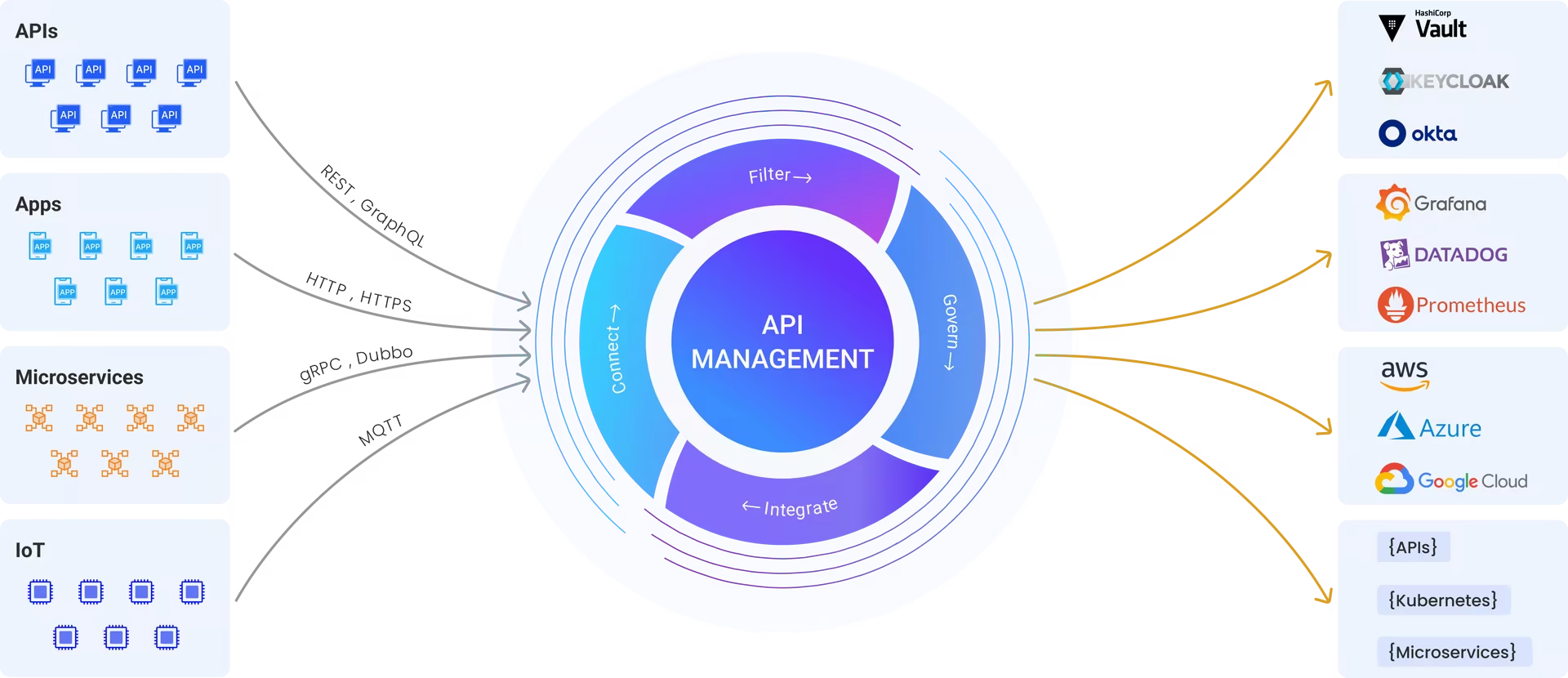
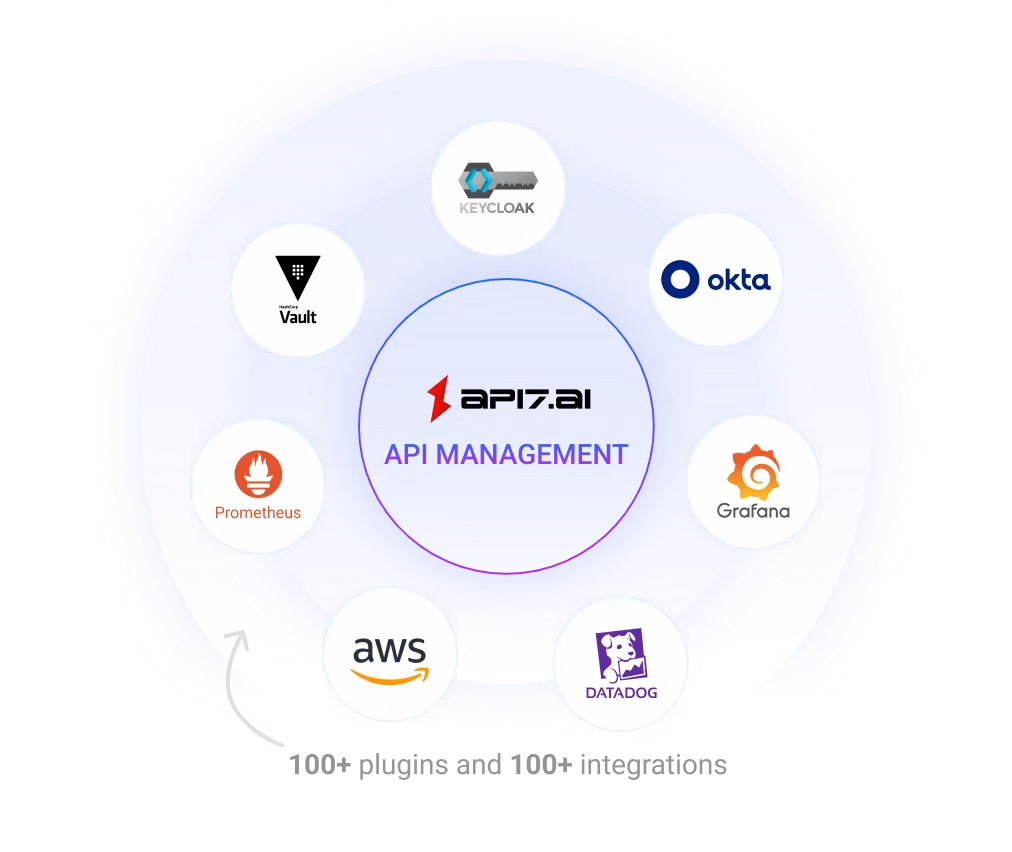
API7's solution excels in tighter integration and collaboration with other enterprise software, encompassing authentication and authorization (Keycloak, PingIdentity, Okta), API portal, and observability tools like Grafana. Enterprises can seamlessly integrate API7 into their existing infrastructure, achieving higher levels of automation and workflow.
This integrated approach significantly enhances efficiency and reduces the complexity of integration. For instance, API7 allows Single Sign-On (SSO) login and authentication, integrating with identity authentication services like Azure AD and Keycloak, minimizing redundant configuration of user information in vendor software procurement. Additionally, API7 supports Role-Based Access Control (RBAC), mapping RBAC policies to internal enterprise policies after SSO authentication, reducing the need for redundant permission configurations. API7 solutions also provides common functions such as integrating with HashiCorp Vault and HashiCorp Consul, to ensure smooth integration of customer businesses to the greatest extent.
4. Compliance and Risk Management
API7 Enterprise and its solution have undergone various compliance certifications, such as SOC2, providing enterprises with enhanced compliance assurance. In contrast, although open-source APISIX follows the Apache 2.0 license, compliance issues remain the responsibility of the enterprise, potentially introducing unnecessary risks and complexities. API7's compliance ensures greater confidence and security for enterprises, allowing direct procurement without concerns about risk compliance issues.
5. Professional Technical Support
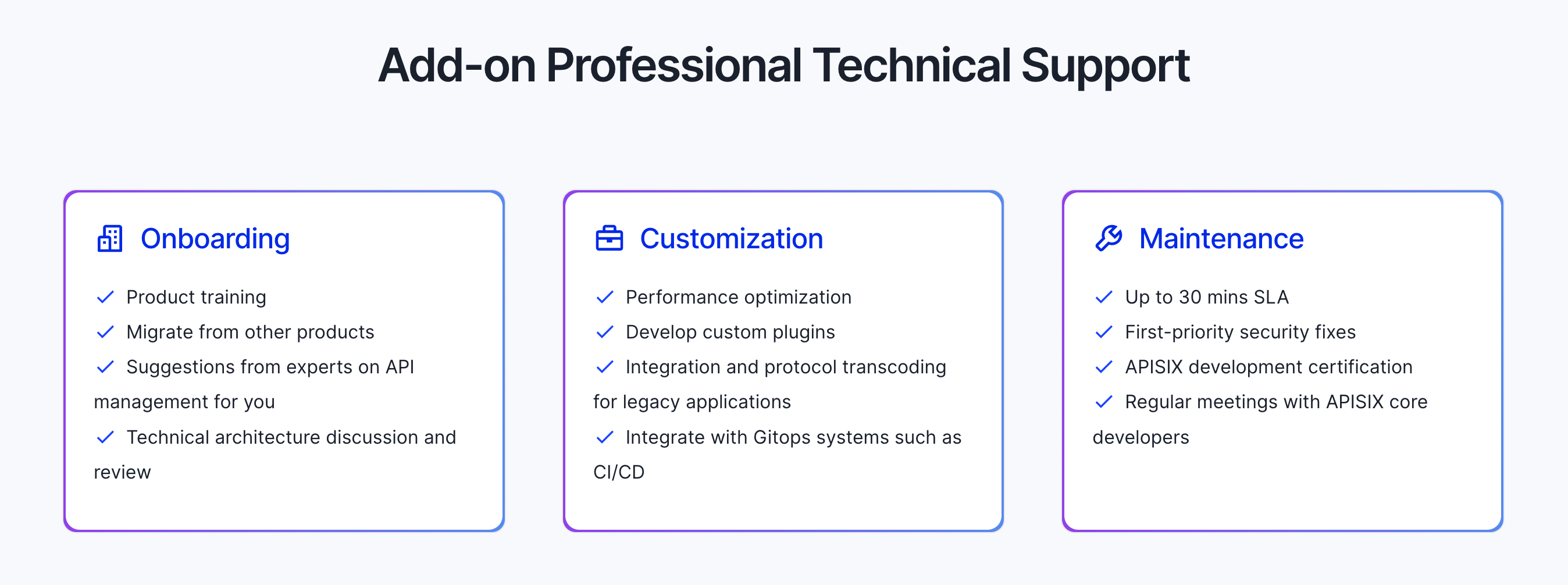
API7 offers commercial assistance for teams that need help beyond community channels. Published support areas include deployment planning, migration, architecture review, performance optimization, security fixes, and training; the exact service scope and response commitments depend on the selected engagement.
For self-hosted deployments, customers remain responsible for the deployment architecture, infrastructure dependencies, operations, and service availability. API7 support can help diagnose incidents and shorten recovery, but it does not replace that operational responsibility.
Teams that plan to keep operating APISIX can review commercial support options for an existing Apache APISIX deployment and confirm which services fit their production requirements.
In conclusion, taking APISIX as a gateway component, the API7 solution offers more value than the open-source Apache APISIX in terms of functionality, security, integration, compliance, and technical support.
For enterprises evaluating an API management and gateway solution, API7 Enterprise offers management, security, governance, and support capabilities. The stability, security, and compliance achieved in a self-hosted deployment depend on its configuration, infrastructure, and customer operations.
API7 vs APISIX Quick Comparison
| Area | What It Means | Why It Matters |
|---|---|---|
| Apache APISIX | Open-source API gateway | Teams that want flexible gateway capabilities and community-driven extensibility |
| API7 Enterprise | Enterprise API management around APISIX | Organizations needing management UI, governance, support, and team workflows |
| Decision factor | Operational ownership and support expectations | Helps choose community or enterprise path |
Explore Apache APISIX, the APISIX vs API7 Enterprise comparison, and API7 Enterprise.
FAQ
Is API7 the same as Apache APISIX?
No. Apache APISIX is the open-source API gateway. API7 provides enterprise products and services around APISIX-based API management.
When should I use Apache APISIX?
Use Apache APISIX when you need an open-source, dynamic API gateway and have the team capacity to operate it.
When should I consider API7 Enterprise?
Consider API7 Enterprise when you need enterprise management, governance, support, and operational workflows around APISIX.