AI Model Gateway: Migrate Models Without Breaking Apps

September 29, 2026
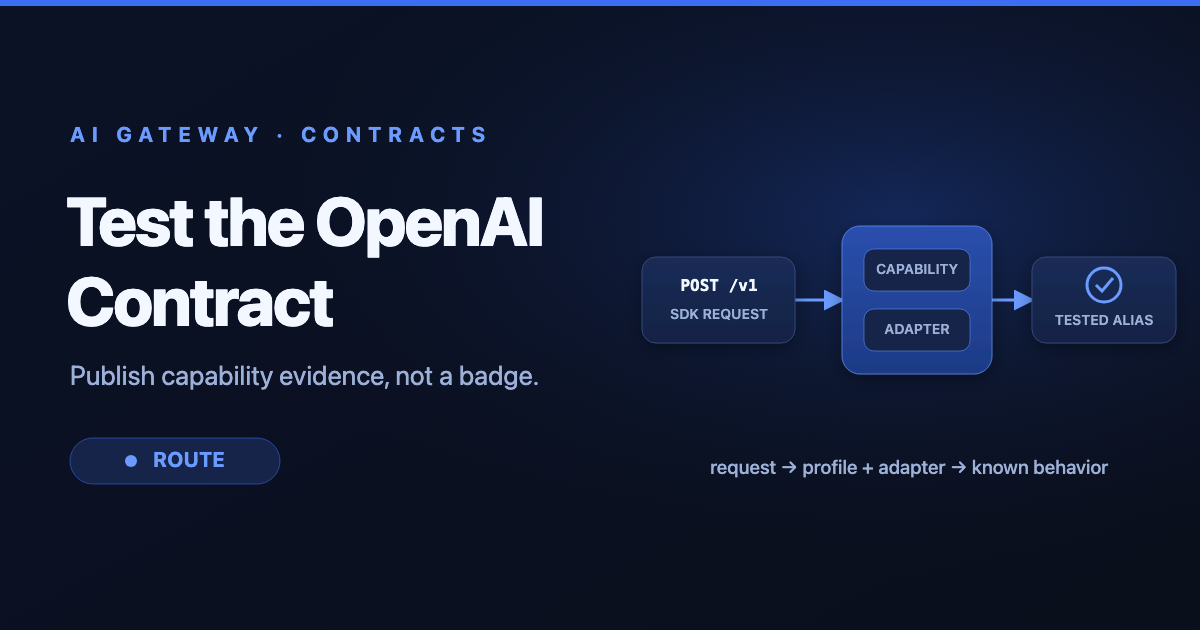
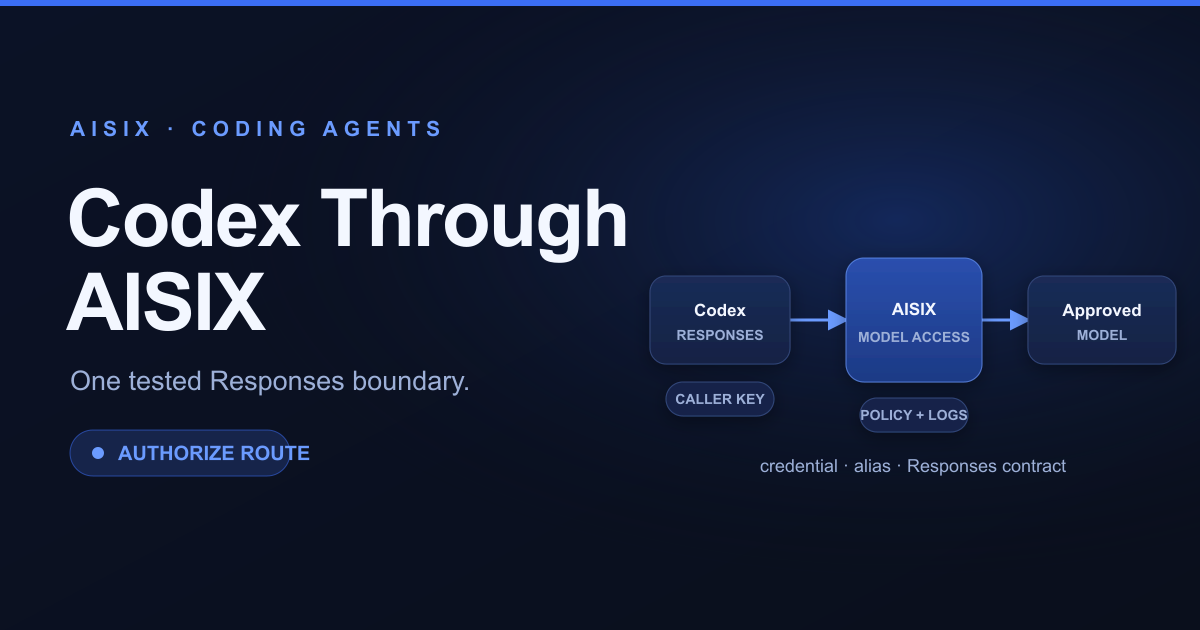
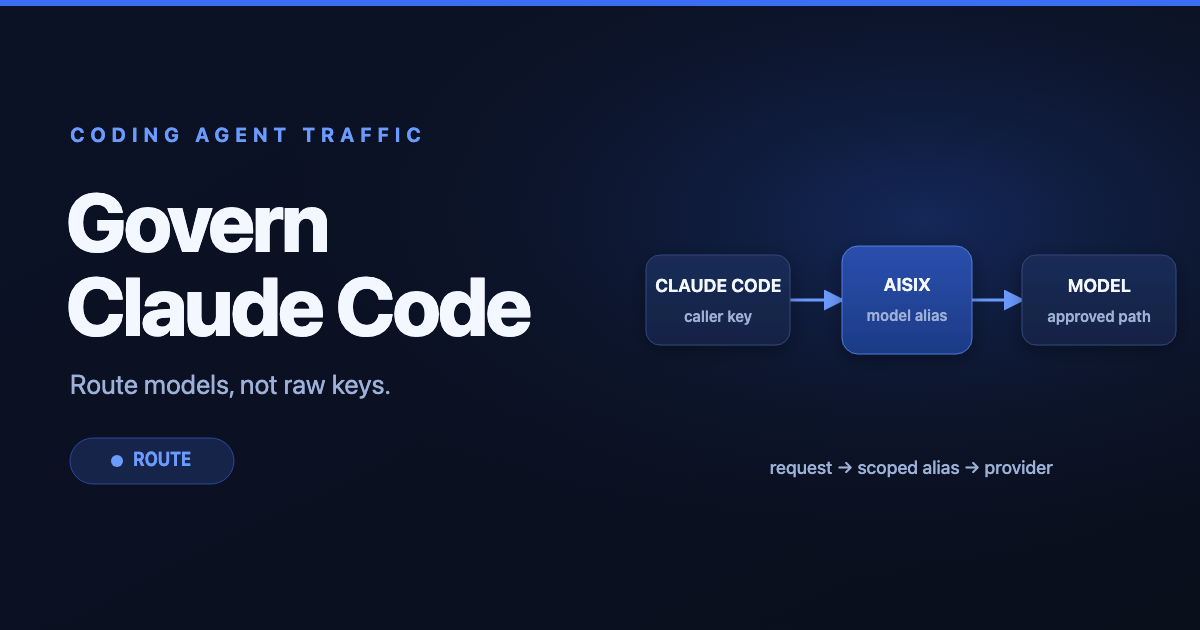
Model retirement should be a platform change, not an application rewrite. An AI model gateway creates a stable contract between applications and upstream models: callers request a durable model alias, while the platform team changes the provider, version, or routing policy behind it.
That indirection is necessary, but it is not sufficient. Two models that accept similar JSON can still differ in tool calling, context windows, safety behavior, latency, pricing, and output quality. A safe migration therefore combines stable aliases with contract tests, representative evaluations, controlled traffic movement, observability, and a tested rollback path.
This article presents a practical migration playbook and shows how AISIX AI Gateway can make model lifecycle changes less disruptive.
Key Takeaways
- Give applications a stable, capability-oriented model name instead of a provider-specific model ID.
- Treat the alias as a versioned behavioral contract, not merely a string replacement.
- Validate request compatibility, tool use, quality, safety, latency, and cost before shifting production traffic.
- Separate candidate testing from production promotion so rollback is a configuration change.
- Observe both the requested alias and the resolved upstream model.
- Do not claim semantic equivalence when two models only share an API shape.
Why Model Churn Breaks More Than a Model Name
Providers regularly introduce new model families, retire snapshots, change recommended versions, and alter availability by region. The official lifecycle pages from OpenAI, Anthropic, Google Cloud, and Microsoft Foundry make one operational fact clear: model migration is recurring work.
Hard-coding upstream model IDs spreads that work across every application. Even when the endpoint remains compatible, a replacement can change:
- supported parameters and their valid ranges;
- context and output token limits;
- tool-call schemas and selection behavior;
- structured-output reliability;
- refusal and content-safety behavior;
- streaming event details;
- regional availability, latency, and price;
- quality on the organization's actual prompts.
An LLM gateway can centralize the mapping, but the organization still needs an explicit contract and rollout process.
Put a Stable Contract in Front of Provider Models
A useful alias describes what the caller needs, not which vendor currently supplies it. Names such as support-chat-standard, code-review-fast, or document-analysis-large age better than an upstream release identifier.
flowchart LR
    A[Applications] -->|model: support-chat-standard| G[AI Model Gateway]
    G --> C{Alias and policy}
    C -->|Current| M1[Provider A model version]
    C -->|Candidate cohort| M2[Provider B model version]
    G --> O[Logs, metrics, traces, and evaluations]
The alias contract should record at least five dimensions:
- API behavior: endpoint, request fields, streaming semantics, error classes, and retry expectations.
- Capabilities: text, images, tools, JSON schema, embeddings, or other modes the application may use.
- Operating limits: context size, output limits, timeouts, concurrency, and rate limits.
- Quality and safety: evaluation thresholds, refusal policy, prompt-injection defenses, and allowed data classes.
- Service objectives: target latency, availability, regions, and cost envelope.
This turns a model alias into a platform contract that can be tested. It also prevents a common mistake: swapping a model because the new endpoint returns HTTP 200 while ignoring whether it still meets the application's behavioral requirements.
How Model Aliases Work in AISIX AI Gateway
The behavior in this section is pinned to AISIX AI Gateway 1.4.0 and the API7 documentation source commit cdc36eb4bd04ead937fef000fa7774b75a4c8395. Verify the current release notes before applying the examples to another version.
In AISIX, the caller-facing display_name is distinct from the upstream model_name. A direct model resource can therefore expose a stable name while the provider-specific identifier remains an implementation detail. The following illustrative open-source configuration follows the documented model alias and resource model:
models:
  - display_name: support-chat-standard
    provider: openai
    model_name: gpt-5-mini
    provider_key: openai-production
Applications send the stable name:
{
  "model": "support-chat-standard",
  "messages": [
    {"role": "user", "content": "Summarize this support case."}
  ]
}
AISIX also supports routing, semantic-routing, and ensemble model resources. In AISIX Cloud, references use resource IDs; in the open-source resources.yaml format, references use display names. Exact aliases take precedence over wildcard aliases, and the most specific matching wildcard wins. These details matter when a platform contains both broad defaults and workload-specific overrides.
An alias hides the upstream name from callers. It does not prove that a replacement model has equal capabilities, quality, safety, or compliance characteristics. Those properties remain the platform team's responsibility.
A Seven-Step Model Migration Playbook
1. Inventory Callers and Deprecation Deadlines
Start with the provider's official retirement notice. Identify every caller, region, tenant, prompt template, tool definition, and policy attached to the current alias. Record the last safe cutover date and allow time for rollback before the provider deadline.
The inventory should include indirect dependencies. For example, an application may never name the upstream model but still depend on its context window, exact JSON behavior, or image support.
2. Create a Candidate Without Moving Production
Register the replacement as a separate candidate resource. Do not immediately repoint the production alias. A candidate name such as support-chat-standard-candidate creates a testable surface for offline evaluation, integration tests, and controlled production cohorts.
Keep credentials and provider configuration centralized. If the candidate belongs to another cloud or vendor, apply the same data-residency and security review used for a new external dependency. The multi-cloud AI gateway guide explains the broader provider portability trade-offs.
3. Run Contract Tests and Representative Evaluations
Contract tests should exercise every feature applications actually use:
| Test area | Minimum checks |
|---|---|
| Request shape | Supported fields, defaults, invalid values, and token limits |
| Response shape | Streaming and non-streaming events, usage fields, finish reasons, and errors |
| Tools | Schema acceptance, tool selection, argument validity, and multi-step behavior |
| Structured output | Schema adherence, truncation, repair rate, and failure mode |
| Safety | Refusals, sensitive-data rules, jailbreak suite, and moderation path |
| Quality | Task-specific golden set, human review, and regression threshold |
| Operations | p50/p95/p99 latency, timeouts, error rate, throughput, and cost |
An evaluation set should represent real traffic without exposing uncontrolled sensitive data. It should also include hard cases and known failures, not only happy paths. API compatibility and task quality are separate gates.
4. Canary a Defined Cohort
Move a small, identifiable cohort to the candidate. Good cohort keys include a platform-controlled tenant group, internal users, or a server-side experiment assignment. Avoid blindly trusting caller-supplied headers for privileged routing; validate or overwrite them at a trusted boundary.
Use a fixed exposure window and explicit stop conditions. For example, halt the canary if tool-call validity drops, p95 latency exceeds the contract, safety regressions appear, or unit cost crosses the approved envelope.
For multi-provider distribution patterns, see AI gateway load balancing. Load balancing can distribute traffic, but it does not replace a migration acceptance gate.
5. Promote by Changing the Gateway Mapping
After the candidate passes the gates, update the mapping behind the stable production alias. Applications should not need a code deployment merely to adopt the new upstream model.
Apply dependent resources in a safe order: provider credentials first, then the model resource, then caller access policy. A configuration write being accepted is not the same as caller-visible readiness. Confirm that the alias appears through the caller-facing model interface and send a real request through the production path.
6. Observe the Requested Alias and Resolved Model
Record both identities:
- the stable alias requested by the application;
- the actual provider and model version selected by the gateway.
The first attributes experience to an application contract; the second distinguishes candidates and provider failures. Track latency, status, timeout stage, tokens, cost, cache behavior, tool outcomes, and evaluation signals. The AI gateway observability guide covers the core telemetry model.
7. Preserve Rollback and Retire Deliberately
Keep the previous model resource, credentials, and validated configuration available through the rollback window. A rollback should restore the previous mapping and policy, not require emergency application releases.
Retire the old resource only after logs show that no production caller depends on it and the provider deadline no longer creates a recovery trap. Archive the evaluation evidence and migration decision for auditability.
Rename and Delete Operations Need Dependency Checks
AISIX Cloud updates many references when a model display name changes, including routing, ensemble, semantic-routing, cache selectors, and caller-key allowlists. One important exception in AISIX 1.4.0 is a rate-limit policy condition that matches model_name: it retains the old value and stops matching until an operator edits it.
Deletion behavior is also dependency-sensitive in AISIX 1.4.0. Routing, semantic-routing, ensemble, semantic-cache or guardrail embedding references, and classic model-scoped rate limits block deletion. Caller-key allowlists and model guardrail attachments are removed automatically. Cache applies_to selectors and conditional model rules remain configured but become inactive. The model-alias lifecycle documentation should therefore be part of the runbook: inspect dependencies, test policy matching, and validate the caller path afterward.
This is exactly why a lifecycle runbook must include policies and access controls, not only model resources.
What an AI Model Gateway Can—and Cannot—Guarantee
An AI model gateway can centralize names, credentials, routing, policy, and telemetry. It can make a tested cutover reversible and reduce application coupling.
It cannot guarantee that two providers interpret prompts identically. It cannot manufacture a capability that the candidate lacks, make a region compliant by configuration alone, or turn an untested model into a safe replacement. Provider failover also does not automatically preserve conversation state or tool side effects.
Use these explicit non-claims in migration reviews:
- OpenAI-compatible request syntax does not imply semantic parity.
- A stable alias does not imply an immutable upstream model.
- A successful canary does not eliminate the need for post-cutover monitoring.
- Routing across providers does not by itself satisfy data residency or contractual requirements.
Migration Checklist
- Pin the source model, target model, gateway version, and provider deadlines.
- Define the alias contract and acceptance thresholds.
- Inventory callers, tools, policies, regions, and data classifications.
- Create a separately addressable candidate.
- Run API contract, task-quality, safety, latency, and cost evaluations.
- Canary a controlled cohort with stop conditions.
- Verify the caller-visible path after configuration changes.
- Observe both requested alias and resolved upstream model.
- Test rollback before full promotion.
- Recheck rate-limit and other name-based policy dependencies.
- Retire the old model only after the rollback window closes.
Make the Next Model Change a Configuration Decision
Model churn is inevitable; application churn is optional. A stable, tested model contract lets platform teams adopt new models while application teams keep using a durable interface.
Explore AISIX AI Gateway to centralize model aliases, provider configuration, policy, routing, and observability—and turn the next model retirement into a controlled platform rollout.