Open Insurance APIs: Security and Traffic Governance

June 3, 2026
Key Takeaways
- Open insurance extends the open finance model into policy, claims, underwriting, broker, and embedded insurance workflows.
- A practical definition of API in insurance is a governed interface that lets trusted applications exchange customer-authorized insurance data or trigger insurance services.
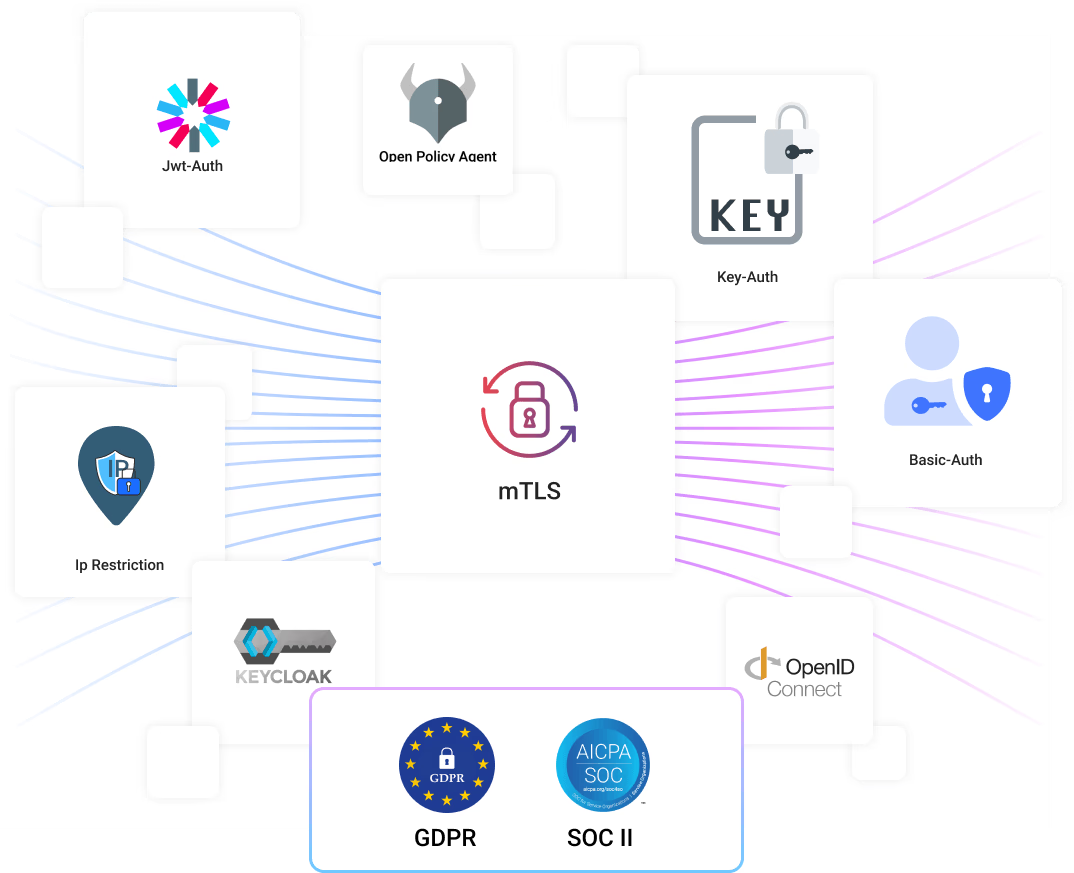
- Security must combine consent, strong customer authentication, token protection, mTLS, fine-grained authorization, and continuous monitoring.
- Compliance is not only a legal checklist. It must be encoded into API design, data minimization, audit logging, retention, and partner onboarding.
- Traffic governance protects core insurance systems from spikes, scraping, partner misuse, retry storms, and downstream outages.
- Apache APISIX and API7 can enforce authentication, rate limiting, routing, observability, and policy controls at the gateway layer.
- Treat open insurance APIs as API as a service products: versioned, documented, measurable, secure, and reliable for external consumers.
What Are Open Insurance APIs?
Before discussing open insurance, it helps to define API in plain terms. API means Application Programming Interface. A useful definition of API is: a contract that lets one software system request data or functionality from another system in a predictable way. In the insurance industry, an API might let a broker retrieve policy status, a customer app submit a claim, a reinsurer receive risk data, or an embedded insurance partner generate a quote during checkout.
Open insurance applies this idea to insurance data and insurance services under a controlled sharing model. It is related to open banking and open finance, but the domain is different. Banking APIs commonly expose account, payment, and transaction flows. Open insurance APIs deal with policies, premiums, beneficiaries, claims, risk attributes, coverages, renewals, and sometimes sensitive health, property, vehicle, or life-event data. The api meaning is therefore not just technical. In open insurance, an API becomes a regulated business boundary.
That boundary is valuable because insurance journeys are rarely contained inside one system. A customer might buy travel coverage through an airline, submit a claim through a mobile app, update identity details through a broker, and compare policies through a marketplace. Without APIs, these integrations often become file transfers, manual reconciliation, and brittle custom connections. With APIs, insurers can build repeatable partner channels while keeping control over data access and service quality.
The challenge is that insurance data is highly sensitive and operationally important. An outage in a quote API can stop digital sales. A weak claims API can expose personal data. A poorly governed partner integration can overload a legacy policy administration system. Designing an API for open insurance therefore requires a layered approach: security by default, compliance by design, and traffic governance from the first production release.
flowchart LR
    Customer[Customer or policyholder]
    Partner[Broker, app, marketplace, or embedded partner]
    Gateway[API gateway policy enforcement]
    Consent[Consent and identity systems]
    Core[Policy, claims, billing, and risk systems]
    Audit[Audit, reporting, and compliance evidence]

    Customer --> Partner
    Partner --> Gateway
    Gateway --> Consent
    Gateway --> Core
    Gateway --> Audit
    Consent --> Audit
    Core --> Audit
The most successful open insurance programs do not treat APIs as one-off integration tasks. They treat them as API as a service offerings. That means clear documentation, developer onboarding, sandbox access, versioning rules, published SLAs, security profiles, usage quotas, and operational dashboards. The API is not only a path into an insurer's systems. It is a product surface that partners depend on.
Security: Build a Financial-Grade Trust Model
Open insurance APIs should borrow heavily from open banking security patterns. The OpenID Foundation's FAPI 2.0 Security Profile builds on OAuth 2.0 and defines a stronger profile for high-risk financial APIs. Open insurance implementations may vary by region, but the same principle applies: when an API exposes customer-authorized financial or insurance data, the baseline must be stronger than ordinary web login.
A secure open insurance API program starts with identity and consent. Customers need to understand which partner is requesting access, what data is requested, why it is needed, and how long access lasts. Partners need strong client authentication. APIs need scopes that map to specific data and actions. Tokens need short lifetimes and careful audience restrictions. Sensitive flows should use stronger protections such as mTLS, proof-of-possession patterns, signed requests, pushed authorization, and phishing-resistant authentication where the regulatory context demands it.
The gateway is not a replacement for identity infrastructure, but it is the practical enforcement point for many controls. It can validate tokens, check client identity, reject malformed traffic, enforce IP or mTLS policies, route requests by partner tier, and emit audit logs. For insurers with many backend systems, this is important because every core system should not have to reimplement the same partner security checks.
sequenceDiagram
    participant User as Policyholder
    participant App as Partner App
    participant IdP as Identity and Consent
    participant GW as API Gateway
    participant API as Insurance API
    participant Audit as Audit Log

    User->>App: Starts quote, claim, or policy flow
    App->>IdP: Requests authorization
    IdP->>User: Authenticates and captures consent
    IdP-->>App: Issues scoped access token
    App->>GW: Calls API with token and client identity
    GW->>GW: Validates token, scope, client, and policy
    GW->>API: Forwards approved request
    API-->>GW: Returns insurance response
    GW->>Audit: Records access decision and metadata
    GW-->>App: Sends response
Security design should also address object-level authorization. For example, a partner may have permission to read policy details, but only for policies authorized by a specific customer or broker agreement. This cannot be solved with a broad policies:read scope alone. The API must verify the relationship among user, partner, policy, and action. OWASP API security incidents often come from broken authorization checks, especially when an API exposes identifiers that clients can manipulate.
Here is a simplified APISIX route that combines OpenID Connect authentication with rate limiting for a partner policy endpoint. The exact identity provider settings will differ, but the pattern is realistic: validate identity at the edge, then protect the downstream service.
routes:
  - uri: /insurance/v1/policies/*
    name: partner-policy-read
    upstream:
      type: roundrobin
      nodes:
        "policy-service.internal:8080": 1
    plugins:
      openid-connect:
        client_id: "${OIDC_CLIENT_ID}"
        client_secret: "${OIDC_CLIENT_SECRET}"
        discovery: "https://idp.example.com/.well-known/openid-configuration"
        scope: "openid insurance.policy.read"
        bearer_only: true
      limit-count:
        count: 1000
        time_window: 60
        rejected_code: 429
        key_type: var
        key: "http_x_partner_id"
        policy: local
This example intentionally uses environment variables for secrets and a partner-specific key for rate limiting. In production, insurers should also add centralized logging, request correlation IDs, sensitive-data masking, and a process for rotating credentials. For higher-assurance use cases, combine gateway checks with mTLS, certificate-bound access tokens, or private network connectivity where appropriate.
Compliance: Encode Requirements Into API Design
Compliance in open insurance depends on jurisdiction, product line, data category, and partner role. It may involve insurance regulations, privacy laws, cybersecurity rules, consumer consent obligations, outsourcing requirements, and audit expectations. The OECD's work on open finance policy considerations highlights that API standards, data protection, consent, and liability models all matter in open finance ecosystems. For insurance, the same themes become especially important because the data can be personal, behavioral, medical, financial, or location-specific.
The mistake many teams make is to treat compliance as documentation after the API has already been built. A better approach is compliance by design. When designing an API, define exactly what data is required for the use case and avoid exposing fields merely because they exist in a backend database. For example, a partner that only needs to verify active coverage should not receive the full policy record, payment history, and claims history. Data minimization should appear in schemas, not only in policy documents.
OpenAPI descriptions are useful here because they make the API contract explicit. The OpenAPI Initiative describes the OpenAPI Specification as a way to describe HTTP APIs in a machine-readable format. For open insurance, an OpenAPI file can become a shared source of truth for endpoints, schemas, authentication methods, error codes, and partner documentation. It also supports governance reviews: security, legal, architecture, and product teams can inspect the same contract before release.
openapi: 3.1.0
info:
  title: Coverage Verification API
  version: 1.0.0
paths:
  /insurance/v1/coverage/verify:
    post:
      summary: Verify whether a customer has active coverage
      security:
        - OAuth2: [insurance.coverage.verify]
      requestBody:
        required: true
        content:
          application/json:
            schema:
              type: object
              required: [customer_id, policy_type]
              properties:
                customer_id:
                  type: string
                  description: Customer identifier authorized by consent record
                policy_type:
                  type: string
                  enum: [auto, home, travel, health]
      responses:
        "200":
          description: Minimal coverage verification result
          content:
            application/json:
              schema:
                type: object
                properties:
                  active:
                    type: boolean
                  coverage_level:
                    type: string
                  expires_at:
                    type: string
                    format: date-time
Notice what is absent from this contract. It does not expose claims history, premium amount, beneficiary data, or underwriting notes. That is a compliance decision expressed as API design. The best compliance controls are often boring in exactly this way: fewer fields, clearer scopes, predictable retention, and auditable access.
Auditability is another major requirement. An insurer should be able to answer: which partner accessed which resource, under which consent, from which client, at what time, with what decision, and with which response category. The audit trail should record metadata, not unnecessary sensitive payloads. It should be searchable for incident response and compliance evidence. Gateway logs, identity provider logs, consent records, and backend application logs must use consistent correlation IDs so investigations do not turn into manual archaeology.
Versioning also matters. If a regulation changes or an insurer tightens a data field, partners need a migration path. Breaking changes should be communicated early, versioned explicitly, and tested in sandbox environments. A good open insurance API program publishes deprecation windows and provides sample migrations. This is where API as a service thinking helps: partner trust depends on predictable operations, not only on correct schemas.
Traffic Governance: Protect Core Systems and Partner Experience
Open insurance APIs often sit in front of systems that were not designed for high-volume external API consumption. Policy administration, claims adjudication, billing, and underwriting platforms may be reliable for internal workflows but fragile under unpredictable partner traffic. Traffic governance is the discipline of shaping, routing, limiting, and observing API traffic so external demand does not harm core systems or customer experience.
The first control is rate limiting. Apache APISIX supports rate limiting through plugins such as limit-count, limit-req, and limit-conn; API7 documentation explains how rate limiting sets quotas and protects APIs from excessive requests, including malicious or automated traffic. In open insurance, rate limits should be designed around business context. A broker quoting API may need burst capacity during business hours. A claims-status API may need steady throughput. A sandbox environment should have lower limits. A suspicious partner should be throttled quickly without affecting others.
flowchart TD
    Request[Incoming partner request]
    Auth{Authenticated and scoped?}
    Quota{Within partner quota?}
    Risk{Risk or anomaly signal?}
    Route[Route to insurance service]
    Throttle[Return 429 or slow request]
    Block[Reject request]
    Observe[Log metrics and audit metadata]

    Request --> Auth
    Auth -- No --> Block
    Auth -- Yes --> Quota
    Quota -- No --> Throttle
    Quota -- Yes --> Risk
    Risk -- High --> Throttle
    Risk -- Normal --> Route
    Block --> Observe
    Throttle --> Observe
    Route --> Observe
Traffic governance should include more than quotas. Insurers need request validation to reject bad payloads before they hit backend systems. They need circuit breakers and timeout policies so a slow claims service does not consume all gateway capacity. They need load balancing and health checks across service instances. They need canary routing for new API versions and partner-specific routing when integrations mature at different speeds.
Here is a practical APISIX-style configuration pattern for separating production partners from sandbox traffic and applying different governance policies.
routes:
  - uri: /insurance/v1/quotes
    name: production-quote-api
    vars:
      - ["http_x_environment", "==", "production"]
    upstream:
      type: roundrobin
      nodes:
        "quote-service-prod-1.internal:8080": 1
        "quote-service-prod-2.internal:8080": 1
    plugins:
      limit-req:
        rate: 50
        burst: 100
        rejected_code: 429
      proxy-rewrite:
        headers:
          X-Service-Tier: "production"

  - uri: /insurance/v1/quotes
    name: sandbox-quote-api
    vars:
      - ["http_x_environment", "==", "sandbox"]
    upstream:
      type: roundrobin
      nodes:
        "quote-service-sandbox.internal:8080": 1
    plugins:
      limit-req:
        rate: 5
        burst: 10
        rejected_code: 429
This pattern is simple, but it reflects a deeper governance principle: not all traffic is equal. Open insurance ecosystems include regulated partners, internal apps, aggregators, sandbox developers, and operational tools. Each class needs a policy. Without this separation, a test integration can compete with a production partner, or a single retry loop can damage the experience for every consumer.
Observability completes the traffic governance model. Metrics should include request rate, latency percentiles, error categories, upstream health, quota rejections, authentication failures, and partner-level usage. Dashboards should answer both business and engineering questions: Which partners are growing? Which APIs produce the most errors? Which backend systems are close to saturation? Which requests are blocked by policy? Without these signals, governance becomes guesswork.
Implementation Guide: Designing an Open Insurance API Program
A strong open insurance API program starts with use-case selection. Do not begin by exposing every core system. Begin with high-value journeys such as coverage verification, quote generation, policy lookup, claims status, document retrieval, or broker onboarding. For each journey, define the consumer, required data, authorization model, risk level, latency target, and operational owner.
Next, create a canonical API contract. This is where designing an API becomes both technical and organizational. The contract should specify paths, methods, request schemas, response schemas, error handling, authentication, scopes, rate limits, and versioning. Use OpenAPI so the contract can feed documentation, testing, mocking, client generation, and review workflows. Keep resource names stable and intuitive. Prefer explicit actions for business workflows that do not map neatly to CRUD.
Then build a layered security model. At minimum, open insurance APIs should include TLS, strong client authentication, OAuth 2.0 or OpenID Connect where applicable, scoped authorization, consent binding, schema validation, and centralized logging. For higher-risk financial-grade flows, evaluate FAPI-aligned patterns. Do not rely on network location as proof of trust. NIST's Zero Trust Architecture guidance emphasizes protecting resources rather than assuming trust because traffic is inside a perimeter; that mindset fits partner API ecosystems well.
Operationally, place an API gateway such as Apache APISIX in front of the insurance services. The gateway should enforce common policy, while backend services enforce business authorization. This separation avoids duplicating generic controls everywhere and keeps domain-specific decisions close to the data. API7 can help teams manage these policies across environments, giving platform teams a consistent way to operate APIs as products.
The following minimal Node.js example shows a backend authorization check that should still happen after gateway validation. The gateway may validate the token and scope, but the service verifies that the policy belongs to the authorized customer and partner relationship.
import express from "express";

const app = express();
app.use(express.json());

async function findPolicy(policyId) {
  return {
    id: policyId,
    customerId: "cust_123",
    brokerPartnerId: "partner_abc",
    status: "active"
  };
}

function requirePolicyAccess(req, policy) {
  const customerId = req.headers["x-customer-id"];
  const partnerId = req.headers["x-partner-id"];

  if (!customerId || !partnerId) {
    throw new Error("Missing caller context");
  }

  const customerMatch = policy.customerId === customerId;
  const partnerMatch = policy.brokerPartnerId === partnerId;

  if (!customerMatch || !partnerMatch) {
    throw new Error("Caller is not authorized for this policy");
  }
}

app.get("/insurance/v1/policies/:policyId", async (req, res) => {
  try {
    const policy = await findPolicy(req.params.policyId);
    requirePolicyAccess(req, policy);

    res.json({
      id: policy.id,
      status: policy.status
    });
  } catch (error) {
    res.status(403).json({
      error: "access_denied",
      message: "The caller is not authorized to access this policy."
    });
  }
});

app.listen(3000);
Finally, create a partner lifecycle. Partners should move through discovery, sandbox, security review, production approval, monitoring, and periodic recertification. Each stage should have measurable requirements. For example, a partner cannot enter production until it passes schema validation tests, security checks, quota configuration, contact registration, and incident notification procedures. This may sound procedural, but it is what prevents open ecosystems from becoming unmanaged integration sprawl.
Conclusion
Open insurance APIs can unlock faster partnerships, embedded insurance journeys, better customer experiences, and reusable digital distribution. But they also create a high-stakes interface between regulated data, external partners, and core insurance operations. The right approach is to treat APIs as governed products, not ad hoc integration endpoints.
Start with a clear definition of API for your organization, then design each API around consent, data minimization, strong authorization, and measurable reliability. Use OpenAPI contracts to make expectations explicit. Apply financial-grade security patterns where risk demands them. Enforce traffic governance through an API gateway so partner growth does not threaten backend stability. With Apache APISIX and API7, insurers can centralize policy enforcement, protect critical systems, and operate open insurance APIs as a reliable API as a service platform.
To continue, review your highest-value insurance partner journey and ask three questions: what data is truly required, who is authorized to use it, and what traffic policy protects the customer experience? Those answers are the foundation of a secure open insurance API program.