HTTP/3 Changes API Debugging: Observe at the Termination Point

November 17, 2026
When an HTTP/1.1 API fails, engineers often start with a proxy or packet capture. HTTP/3 changes what those tools can see. The exchange still has a request method, path, and headers plus a response status, but it travels over QUIC on UDP, its protected packets do not expose application data, and its headers use QPACK rather than HTTP/2's HPACK.
A recent hands-on post about intercepting HTTP/3 traffic reached Hacker News and sparked a useful trust-boundary discussion. The operational lesson is broader than one interception tool: API teams need to observe HTTP semantics where the protocol is terminated, then correlate that evidence with the gateway and service hops that follow.
The goal is not to decrypt production traffic everywhere. It is to give each layer enough trustworthy telemetry to answer whether failure occurred during HTTP/3 discovery, QUIC connection establishment, edge processing, gateway policy, upstream connection, or application execution.
Key Takeaways
- HTTP/3 carries HTTP semantics over QUIC; a TCP-only proxy does not automatically observe that path.
- A packet capture remains useful for network timing and reachability, but protected application data needs endpoint secrets or an authorized termination point.
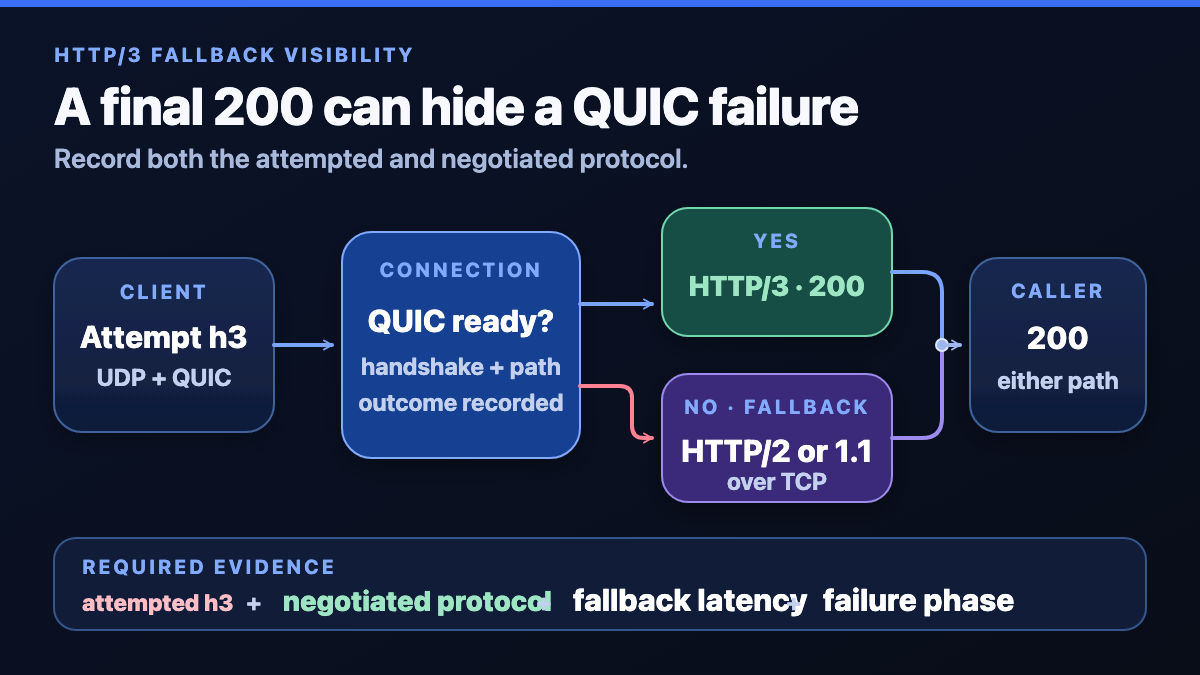
- Silent fallback to HTTP/2 or HTTP/1.1 can hide an HTTP/3-specific failure.
- Record the negotiated protocol at the client-facing edge and the protocol on each downstream hop.
- Propagate trace context across termination boundaries, but do not treat a caller-supplied ID as trusted identity.
- Apache APISIX can provide gateway-hop telemetry behind an HTTP/3-capable edge; this article does not claim APISIX 3.19 terminates HTTP/3.
HTTP Semantics Stay; the Transport Changes
RFC 9114 maps HTTP semantics onto QUIC. QUIC version 1 runs over UDP and uses TLS 1.3 or later as its handshake protocol. HTTP/3 is selected with the h3 ALPN token, and an HTTPS origin can advertise an alternative HTTP/3 service with Alt-Svc.
That produces a different wire path from HTTP/2:
flowchart LR
    Client[Client: HTTP/3] -->|UDP + QUIC + TLS| Edge[HTTP/3 termination]
    Edge -->|HTTP/2 or HTTP/1.1| Gateway[API gateway policy]
    Gateway -->|upstream protocol| Service[Application]
The arrows are separate connections. A successful HTTP/3 client-to-edge request does not prove the edge-to-gateway or gateway-to-service hop used HTTP/3. Conversely, a gateway trace can show a healthy upstream request while omitting a delay that occurred before the edge finished QUIC setup.
QUIC packet protection is not an optional wrapper. RFC 9001 derives packet-protection keys from TLS and protects handshake, 0-RTT, and 1-RTT packets at different encryption levels. Initial packets use derivable keys and are not confidential, but application data is protected. A raw capture alone should not be expected to reveal request headers and bodies.
HTTP/3 also replaces HPACK with QPACK. QPACK uses encoder and decoder streams to coordinate compression state without assuming the total ordering available to HTTP/2 over TCP. That means “find the header bytes in this packet” is the wrong debugging model even after stream data is available.
Define the Observation Points Before the Incident
Use four complementary views:
| Observation point | Can establish | Cannot establish alone |
|---|---|---|
| Client | Requested URL, attempted protocol, client timing, fallback outcome | Edge policy and upstream execution |
| Network capture | UDP arrivals at that capture point, addresses, packet sizes and timing, and connection IDs when present | Protected HTTP fields or a reliable end-to-end loss conclusion without endpoint metrics or authorized secrets |
| HTTP/3 terminator | Negotiated ALPN, QUIC/TLS outcome, decoded HTTP request, edge response | Downstream gateway and application behavior unless correlated |
| Gateway and service | Route, policy, upstream timing, application spans and status | Pre-termination HTTP/3 discovery and handshake failure |
No single view is “the truth” for the whole request. The useful unit is a correlated timeline with the trust and protocol boundary of each timestamp stated explicitly.
For example, an edge may return a 503 before forwarding anything. The gateway correctly has no trace. Or the edge may forward a request and the gateway may reject it before the service receives it. Missing application telemetry then reflects policy timing, not necessarily broken tracing.
Detect Fallback Instead of Calling It Success
RFC 9114 says connectivity problems such as blocked UDP can prevent a QUIC connection and clients should attempt a TCP-based HTTP version. That improves reachability, but it can conceal an HTTP/3 regression.
Track at least:
- advertised protocols and the age of the
Alt-Svcrecord; - attempted and negotiated protocol;
- QUIC handshake success, failure category, and time;
- fallback protocol and added latency;
- edge-to-gateway protocol;
- gateway-to-upstream protocol;
- status and failure phase.
Do not infer that a 200 response proves HTTP/3 worked. A client may have retried over HTTP/2. Likewise, do not label every UDP failure an attack; enterprise firewalls, carrier networks, NAT behavior, and stale advertisements can all affect the path.
Canary HTTP/3 separately from the TCP fallback. Synthetic checks should report both the final HTTP result and the negotiated transport. During a rollback, remove or shorten advertisements deliberately and account for client caching rather than assuming every client immediately returns to the old path.
Correlate Across the Termination Boundary
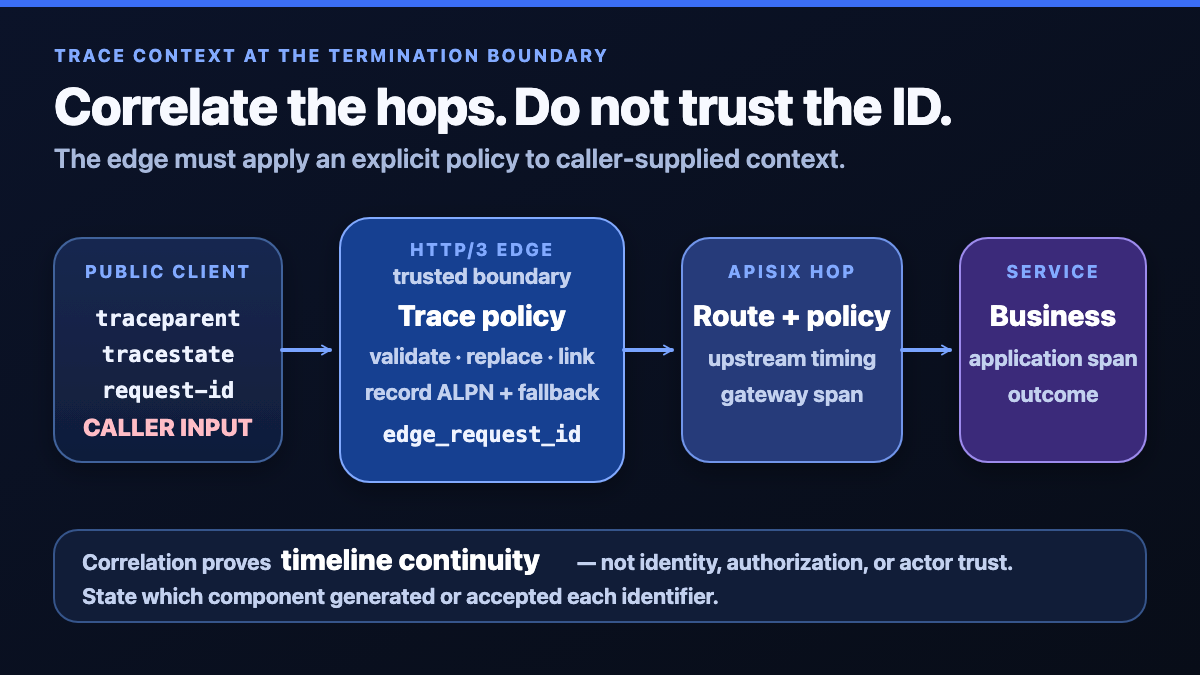
The W3C Trace Context specification defines traceparent and tracestate headers for propagating request context. Because HTTP semantics survive the transport change, a trusted edge can forward trace context to the gateway and application.
Trust still matters. A public client can supply traceparent, tracestate, or a request ID. Decide whether the edge accepts, validates, replaces, or links that context. A correlation value is useful evidence but is not a caller identity, authorization result, or proof that two events came from the same trusted actor.
At each hop, attach fields such as:
- edge request identifier generated at the trusted boundary;
- client-facing protocol and ALPN;
- fallback result;
- gateway route and upstream identifier;
- policy outcome and rejection phase;
- upstream connect, first-byte, and total duration;
- application span and business outcome.
Avoid placing credentials, full query strings, or personal data into span attributes. High-cardinality connection identifiers can also create cost and privacy problems; retain only the detail required for a bounded investigation.
API7's API observability guide explains how metrics, logs, traces, and SLOs complement one another. HTTP/3 adds another reason not to ask one signal to carry the entire investigation.
Place Gateway Telemetry in the Right Scope
If an HTTP/3-capable CDN, load balancer, or edge proxy terminates QUIC and forwards HTTP/2 or HTTP/1.1, Apache APISIX can observe the gateway-facing request and its upstream work. That does not make the APISIX span an HTTP/3 handshake span.
In Apache APISIX 3.19, the opentelemetry plugin reports tracing data and supports binary-encoded OTLP over HTTP. The plugin is disabled in the default plugin list and must be enabled in configuration. On a route, its documented sampler defaults to always_off, so enabling the plugin binary without setting an appropriate sampler does not mean route spans will appear.
The same documentation notes that comprehensive request-lifecycle tracing adds span creation and export overhead that can affect throughput and latency. Choose sampling from the incident and SLO requirements, test collector failure behavior, and avoid changing every route to always_on during a traffic spike without estimating the added load.
This version-pinned description is intentionally narrow. It does not claim APISIX 3.19 accepts client HTTP/3 connections, exports QUIC transport internals, or reconstructs telemetry that an outer edge never forwarded. Collect HTTP/3 connection evidence at the component that actually terminates QUIC.
Use Decryption Only in a Controlled Lab
When decoded wire evidence is necessary, reproduce with a client and server you control. Wireshark documents TLS decryption using a key log file, and HTTP/3-aware tooling can combine secrets with QUIC and QPACK dissection.
Treat those secrets as sensitive. Do not enable broad production key logging merely to make packet captures convenient. A trusted interception proxy also changes the trust path: the client must trust its certificate authority, and certificate-pinned applications may reject it. Results from that lab prove behavior under the lab's trust configuration, not that arbitrary encrypted traffic can be inspected.
A focused reproduction sequence is:
- Confirm the client build supports HTTP/3.
- Record DNS and
Alt-Svcdiscovery. - Force an HTTP/3 attempt and record the negotiated protocol.
- Repeat with UDP blocked to verify the expected fallback.
- Correlate the edge event, gateway trace, and application span.
- Use authorized key logging only if the failure remains below the HTTP layer.
Document the client, QUIC implementation, edge configuration, and gateway version. HTTP/3 behavior can differ across implementations even when the HTTP contract is the same.
Debug the Phase, Not Just the Status
HTTP/3 does not make APIs unobservable. It makes the termination boundary impossible to ignore.
Start by drawing the real connection graph. Mark where QUIC ends, which protocol begins on the next hop, who generates the trusted request ID, and where each metric or span is recorded. Then test HTTP/3 success, UDP failure with fallback, edge rejection, gateway rejection, and upstream failure as separate cases.
For the gateway hop, review end-to-end tracing with OpenTelemetry and the Apache APISIX observability plugins. For managed API traffic policy and observability, explore API7 Enterprise while keeping HTTP/3 transport evidence at the component that terminates it.