API Contracts Outlive Runtimes: Lessons from Deno's Transition

October 13, 2026
When a runtime changes direction, application teams face two migrations at once. They must move code and infrastructure, but they must also keep the API behavior that clients already depend on. Treating those as one problem turns every implementation change into a consumer incident.
The distinction became concrete this week. On October 9, 2026, Deno announced that its team is joining Cloudflare. The team plans monthly bug-fix and security releases for the Deno runtime for another year, after which it will end its own runtime development. Deno Deploy is scheduled to operate for six months, while JSR will continue and move its infrastructure to Cloudflare. Cloudflare's announcement adds that the teams intend to combine work around workerd and celld to improve self-hosted Workers and Durable Objects.
The Hacker News discussion focused on runtime longevity and migration risk. The useful lesson is broader than JavaScript: a runtime is an implementation choice, while a public API is a contract. An API gateway can help preserve and measure the contract during a migration, but it cannot make incompatible code, storage, or execution semantics portable.
Key Takeaways
- Separate the client-facing API contract from the runtime-specific origin implementation.
- Inventory observable behavior before moving traffic: paths, methods, schemas, status codes, headers, streaming, timeouts, and identity.
- Run old and new origins behind one gateway and compare them before shifting meaningful traffic.
- Use weighted or condition-based routing for exposure control, not as proof of compatibility.
- Keep state migration, background jobs, WebSockets, and platform bindings in a separate workstream.
- Preserve a fast rollback path until both API evidence and runtime operations are stable.
What the Deno News Does and Does Not Mean
The official announcements are precise about direction. Deno remains open source, JSR continues, and Cloudflare is investing in a shared platform around Workers and Durable Objects. They do not say that every Deno application will run unchanged on Cloudflare Workers or a self-hosted workerd deployment.
That difference matters because runtime portability has several layers:
| Layer | Migration question | Can an API gateway solve it? |
|---|---|---|
| Language and module system | Do imports, permissions, Node compatibility, and build tools behave the same? | No |
| Runtime APIs | Are filesystem, sockets, subprocesses, timers, and environment access compatible? | No |
| Platform services | How do storage, queues, scheduled work, and durable state map? | No |
| API contract | Do clients see the same routes, auth, schemas, headers, errors, and streaming behavior? | Partly; the gateway can route, adapt selected fields, and observe the boundary |
| Rollout | How is traffic shifted, compared, and rolled back? | Yes, when explicitly configured and tested |
A gateway is therefore a migration control point, not a runtime translator. It can keep api.example.com stable while old and new backends coexist. It cannot turn a Deno-specific storage call into a Durable Object transaction or preserve an in-memory session after a process moves.
Define the Contract Before the Destination
Teams often begin with a list of source files. Clients experience a different surface. Build the migration inventory from requests and responses instead:
- hostnames, paths, methods, query handling, and redirects;
- authentication inputs and the identity established from them;
- request and response schemas, including unknown-field behavior;
- status codes, error bodies, and retry-relevant headers;
- streaming framing, flush timing, cancellation, and idle timeouts;
- caching, compression, CORS, and content negotiation;
- rate-limit semantics and idempotency behavior;
- WebSocket or long-lived connection lifecycle.
This is the same discipline used in preventing breaking API changes: compatibility depends on behavior, not only on a matching URL. Generate contract tests from production evidence where privacy rules permit, then add deliberately adversarial cases such as malformed JSON, oversized bodies, canceled streams, expired credentials, and duplicated idempotency keys.
Record which component owns each behavior. If the gateway adds authentication, CORS, or a response header, the new origin should not accidentally add a conflicting version. If the application generates the error schema, do not assume a gateway rewrite will cover every branch.
Put Both Origins Behind One Stable Edge
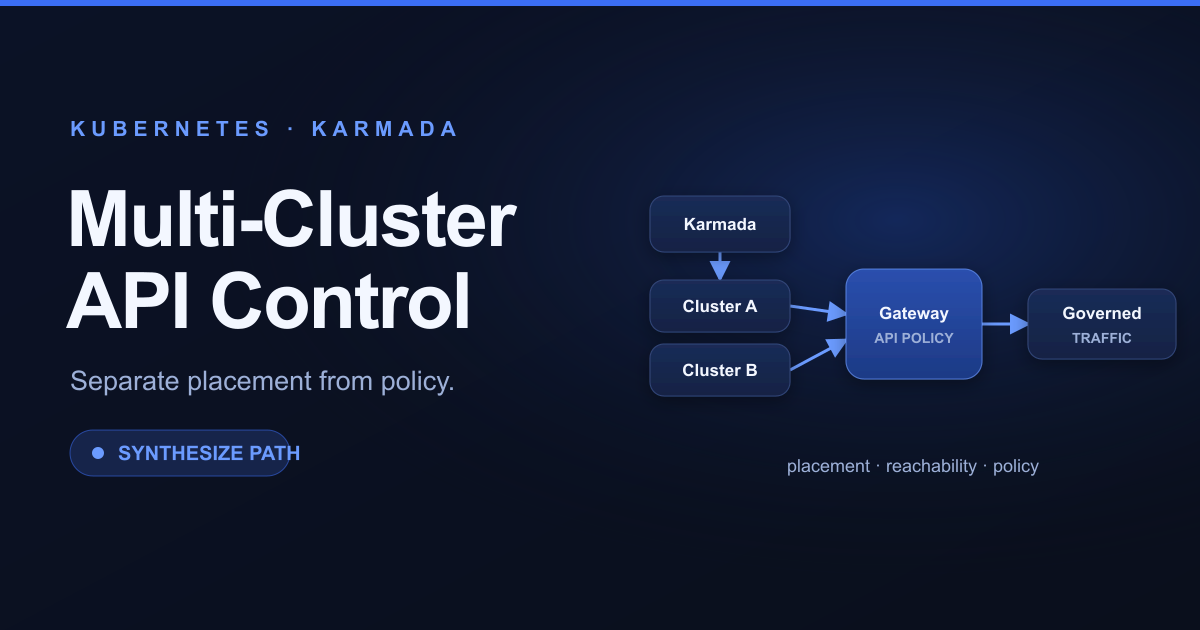
A practical migration topology keeps the public route stable and changes only the selected upstream:
flowchart LR
    C[API clients] --> G[API gateway contract]
    G -->|baseline traffic| O[Existing runtime]
    G -->|shadow or canary traffic| N[New runtime]
    O --> E[Contract and SLO evidence]
    N --> E
The diagram makes one promise: the gateway controls which origin receives an in-scope request. It does not imply that shadow traffic is automatically safe, that writes can be duplicated, or that the two origins share state.
API7 Enterprise's canary guide shows weighted routing with the traffic-split plugin. Apache APISIX 3.19 documents the same condition- and weight-based traffic splitting. Weighted round robin is approximate, especially after state resets, so validate real request counts rather than expecting an exact percentage over a small sample.
Start with traffic that is safe to replay: health checks, synthetic requests, or read-only operations. Shadowing a purchase, email send, or state mutation can create duplicate side effects even when the response is discarded.
Compare Behavior, Not Just HTTP 200
A canary that returns 200 can still be incompatible. Compare the dimensions that affect callers:
- Schema: required fields, types, null handling, ordering where clients depend on it, and unknown fields.
- Errors: status, machine-readable code, message stability, and
Retry-Afterbehavior. - Latency: time to headers, full response time, stream startup, and tail latency.
- Headers: caching, CORS, content type, deprecation, and tracing headers.
- Identity: the same credential must establish the same effective permissions.
- Side effects: idempotency, transaction boundaries, events, and downstream calls.
Use gateway metrics and logs to compare route, status class, latency, and selected upstream. Use application traces and data checks for semantics the gateway cannot observe. A matching byte sequence is strong evidence for a read, but it is not proof that background work or stored state is correct.
Avoid using a request ID as trusted identity. It may be generated by the gateway, preserved from a caller, or rewritten by another intermediary. Attribution should come from the authenticated principal and its verified mapping, not from a correlation field.
Treat Stateful Features as Separate Migrations
Runtime transitions become risky when teams hide stateful differences behind a stateless routing plan. Review these paths independently:
- WebSockets and server-sent events that cannot move mid-connection;
- in-memory sessions or local caches that disappear on restart;
- queues and scheduled jobs that might run in both systems;
- file or object storage consistency;
- database transactions and connection pooling;
- provider-specific bindings, permissions, and secrets;
- background retries after the client has already received a response.
For long-lived connections, a gateway can direct new handshakes to the new origin, but an established connection normally remains with the old one until it closes. A rollback protects new connections; it does not rewind messages already processed by the canary.
If both runtimes consume the same queue, decide which one owns retries and dead letters. If both write the same database, confirm schema compatibility in both directions before a rollback. These are application and data-plane decisions, even when the gateway controls ingress.
Build a Migration Gate with Counterexamples
Before increasing traffic, try to disprove compatibility:
| Counterexample | What it catches |
|---|---|
| Missing and malformed auth | Different failure stages or accidental bypass |
| Unknown JSON field | Strict-versus-permissive decoder changes |
| Client cancellation mid-stream | Leaked work and incorrect final status |
| Duplicate idempotency key | Double processing after retry or failover |
| Old client version | Hidden coupling to new fields or headers |
| Origin timeout | Retry multiplication across client, gateway, and runtime |
| Rollback after a new write | One-way schema or state migration |
Define thresholds before the test: acceptable schema differences, error rates, P95/P99 latency, and state reconciliation. Do not call the canary “verified” merely because no alert fired. The test must include the failure branches that matter to the API.
A Four-Stage Runtime Migration
Use a staged sequence that preserves evidence and reversibility:
- Baseline: capture the current contract and service objectives at the gateway and application.
- Parallel validation: deploy the new runtime without public traffic; run contract and failure tests.
- Controlled exposure: route a small, identifiable cohort or weight to the new origin and compare outcomes.
- Cutover and observation: increase traffic gradually, keep the old origin ready, and remove it only after stateful paths and rollback criteria are satisfied.
The gateway configuration should be versioned with the application rollout. A route change without the matching origin release can send traffic to the wrong protocol, path, or TLS expectation. Likewise, deleting the old route too early converts a recoverable migration into an emergency redeploy.
Keep the Contract Stable While the Runtime Changes
The Deno transition is a timely reminder that infrastructure roadmaps change faster than many API consumers. The response should not be to freeze every runtime decision. It should be to make the external contract explicit, testable, and independently operable.
An API gateway gives platform teams a stable entry point, controlled traffic shifts, and shared evidence. Runtime compatibility, state migration, and application correctness still require their own proof. Start by inventorying one public API, place both origins behind the same tested route, and use a small canary to learn where the real portability boundary lies.
To build the traffic-control layer, review API7 Enterprise or the open-source Apache APISIX gateway, then keep the migration plan honest about what the gateway does not translate.